
The Story
Why it exists.
The beginning
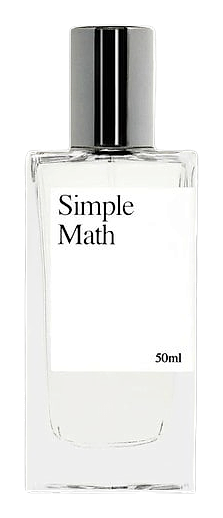
Simple Math is a composition built around an electricity you don't usually find in a bottle. Not the warm bulb variety, but something colder, sharper, more abstract. A sensation most people associate with the crackle before a thunderstorm or the charge in a room full of old electronics. It's an olfactive territory Pour Toi has explored before in other compositions, but Simple Math feels like the version where everything lined up, where the idea was pushed furthest and the metallic, static-laced character was given the room it needed to actually breathe. What makes it land isn't novelty for its own sake; it's the precision of the execution.
What makes this composition unusual is its refusal to behave like a traditional floral. The rose here doesn't bloom so much as charge, sitting inside a metallic shell rather than floating above it. Dust and woody notes provide texture without warmth, and the musk underneath is clinical rather than skin-like. The electro-statical accord runs through every phase like a current through copper wire, binding the elements into something coherent without smoothing them out. It's a scent built from contradictions that somehow hold.
The evolution
The first thirty minutes are the coldest stretch. Metallic notes and that electro-statical accord arrive almost aggressively, sharp and clean in a way that reads more laboratory than perfume. There's no fruit to soften the landing, no vanilla cushion underneath. Just the flat grey hum of something powered on. The opening has almost no give. It's a wall of clean, cool, charged air that sits close to the skin and doesn't reach outward the way most openings do. Every breath you catch off your wrist in this window reinforces the same impression: this is a composition that wants to be felt before it's understood. Around the two-hour mark, the rose emerges, but quietly. It doesn't so much bloom as settle in, powdery and slightly wilted, like pressed flowers kept in a drawer.
Cultural impact
Simple Math has found a particular kind of wearer: people drawn to fragrance as concept rather than comfort. The reviews and discussion around it lean heavily on language borrowed from technology and memory, old televisions, static-laced radios, the quiet hum of devices left running overnight, and that vocabulary says something real about how the scent lands. It isn't a fragrance people reach for when they want to feel polished or romantic. It's one they reach for when they want to feel something harder to categorize, something that sits closer to atmosphere than to accessory.