
The Story
Why it exists.
The beginning
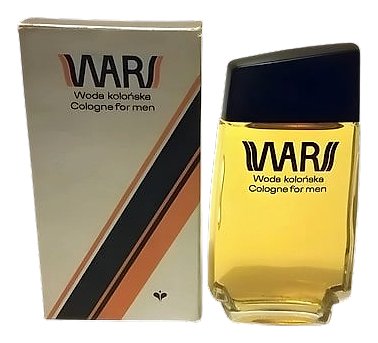
Wars came from Pollena Uroda, Poland's state-run fragrance house. The Eastern Bloc perfume industry had its own logic: create scents that last, that project, that serve the practical man who needed something reliable for the workday and beyond. No niche positioning, no celebrity endorsements, no instagram-worthy flacons. Just composition. The brief for Wars was straightforward: citrus for the morning sharpness, woody notes to anchor it, enough floral warmth to keep it from feeling like industrial cleaner. White cedar extract as a top note gave the opening a slight turpentine edge that seasoned quickly into something warmer. The woody base settles into the wearer's skin chemistry, offering a subtle but persistent presence that carries through the day.
The note structure of Wars reveals an interesting constraint: three tiers, each with minimal variation. Top: citruses and white cedar. Heart: sandalwood and a generic floral accord. Base: woody notes in aggregate. No spice list, no named exotic materials, no precious naturals pulling weight. This economy isn't a weakness. It's a philosophy. The perfumer worked within boundaries that Western houses would have found creatively suffocating, but those same boundaries forced clarity. Every material had to pull double duty. The white cedar extract needed to open sharp and fade warm, it had to serve as both citrus substitute and early wood bridge simultaneously.
The evolution
The opening hits with that slightly astringent white cedar, citruses doing their quick work before the resinous undertone takes over. Thirty seconds in, the citrus has already receded. The cedar remains, but it's softened, almost immediately joined by something powdery from the floral heart. The sandalwood announces itself around the five-minute mark. Not the creamy sandalwood of high-end niche, this is a drier, more diffuse version that serves more as a bridge than a destination. The floral notes weave through without dominating, adding warmth and a subtle sweetness that balances the woody elements. The effect is warm and slightly sweet, the powdery quality more pronounced than you might expect from a 1980s men's fragrance. By the second hour, the woody base has fully arrived. The composition settles close to skin, projecting for several hours on most wearers.
Cultural impact
Wars arrived during the 1980s as a product of Poland's cosmetics industry, part of a system where fragrance production served domestic demand and allied nations rather than global export. Pollena Uroda operated within a planned economy that prioritized utility and availability over luxury positioning. This era placed Wars in a particular moment in perfumery, a period when consumers had limited access to certain Western brands and relied on domestically produced alternatives. These fragrances circulated across allied nations, creating a shared olfactory culture that spanned borders.