
The Story
Why it exists.
The beginning
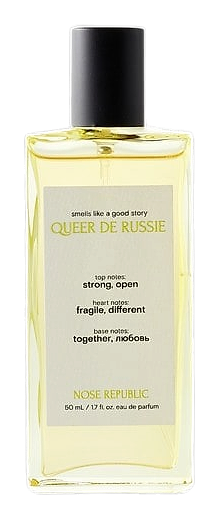
The name is the provocation. "Queer", a word carrying as many meanings as there are identities, and "Russie," a nod to a culture where the word itself has had to fight for space. Valery Mikhalitsyn built Queer de Russie as a counterargument to what leather fragrances are supposed to smell like. Not the cold, hard leather of tradition. Not the austere cuirs of perfumery's old guard. Something warmer. Something that sparkles. The brief was leather reimagined through the lens of movement and multiplicity, bright where it should be dark, sweet where it should be serious.
What makes the structure unusual is the ginger concentration. At roughly 10% of the formula, it's not a background player, it's the protagonist. Ginger CO2 extract behaves differently from distilled ginger oil: more immediate, more aromatic, less dry. It hits the nose like fresh-cut root, bright and almost citrus-adjacent, before settling into the composition's warmer register. This structural choice is what allows the leather to stay soft rather than sharp, what keeps the melon sweetness from reading as a simple fruit salad. The ginger is the architecture.
The evolution
The opening announces itself immediately: latex and ginger, vinyl and fresh-cut root, cool and hot at the same time. There's something almost ozonic here, not oceanic in the traditional sense, but the clean plastic scent of a pool toy, a new basketball, something that holds air. The melon arrives next, watery and sweet, not quite ripe, and the ylang-ylang lifts it into something more floral. Peach lingers at the edges, keeping things soft. The leather doesn't hit immediately. It waits. Builds underneath, patient. The heart phase is where suede arrives, fuzzy, warm, close to skin. Labdanum adds a resinous amber quality that keeps the sweetness from floating away. The patchouli grounds everything, earthy and deep, as the ginger slowly recalibrates from sharp to warm. By the drydown, the ginger is still there, threaded through the composition like memory, but it reads differently now. The final hours belong to suede and patchouli, sweet and warm, close to the skin, present on fabric the next morning.
Cultural impact
The fragrance occupies a specific and somewhat isolated position in contemporary perfumery, synthetic-fruity-leathery with an unusually high ginger concentration. Wearers describe it as unusual, polarizing, memorable. The name generates conversation before the bottle is opened. Some find the ginger-leather combination genuinely unique; others bounce off the synthetic facets. That polarization is part of the point, the fragrance was designed to reject easy categorization, much like the identity it references.
The House
Nos RepublicNos Republic is a Swedish fragrance house that emerged from an eponymous perfume blog written by Ksenia Golovanova, who serves as co-founder and creative force behind the brand. Established in 2023, the brand quickly gained recognition for a collection of six narrative-driven fragrances released that same year, with each scent representing an inspiring story. The brand later expanded its portfolio with Cor Serpentis in 2025. Nos Republic represents a distinct approach to perfumery where storytelling and emotional resonance take precedence, creating scents that function as olfactory narratives rather than simple aromatic compositions. Based in Sweden, the brand draws on its Nordic context while embracing a distinctly international creative sensibility informed by Golovanova's background as a perfume blogger.
The Creator
Valery MikhalitsynAs a writer rather than a creator, Mikhalitsyn's style manifests in his prose rather than in formulations. His fragrance analyses are known for their precision and restraint, avoiding hyperbole in favor of careful description.