
The Story
Why it exists.
The beginning
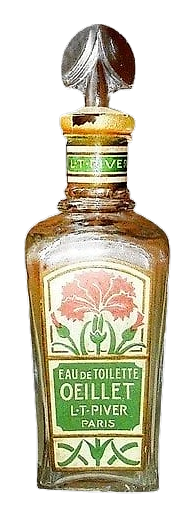
Oeillet arrived in 1905 from L.T. Piver, the French house that traces its roots back to 1774. The name means carnation in French, and the fragrance does what good soliflores do: it commits to one flower and lets that flower argue on its own behalf. Piver's version leans into the natural duality of carnation without ornament. There is no exotic muse, no romance of the orient. Just a carnation, rendered with the house's characteristic restraint. The composition opens with the spicy-sweet warmth the flower is known for, then pulls back and lets the floral facets speak for themselves. Piver trusted that one ingredient, properly handled, could fill an entire room.
In a composition built around a single flower, the natural complexity of carnation becomes the entire architecture. Piver understood that a carnation does not need backup singers. The flower itself supplies the warmth, the spice, the sweetness, and a faint green stem-coolness underneath. Building a fragrance around it is a study in what happens when a perfumer trusts one ingredient to carry the room.
The evolution
The opening is the loudest the fragrance will be. Eugenol-forward carnation hits with a clove-sweet intensity that almost reads as confectionary, like pink rock candy dusted with spice. There's a green sharpness underneath, the cool snap of a stem just cut. As the minutes pass, the clove heat recedes and the softer floral facets take over. The carnation becomes rounder, almost waxy, and a faint powdery warmth starts to gather at the base. Eventually, the fragrance settles into its quiet register: warm, sweet-spiced, close to the skin, with just enough presence to catch notice when someone leans in. The drydown lingers as a soft, soapy-musky warmth. A scarf can carry a ghost of it into the next day, the kind of trace that makes you lean closer without knowing why.
Cultural impact
Oeillet belongs to a tradition of single-flower compositions that treated one botanical as a full subject for a fragrance rather than a note in a larger structure. Alongside Piver's own Héliotrope Blanc, it sits in a catalog that rewards attention to raw materials over storytelling. These compositions attract wearers who value historical accuracy over modern reinvention, and who prefer their perfume library to read as an archive rather than a mood board. Oeillet's appeal is narrow and specific: the wearer who chooses it is choosing a documented moment in French perfumery, not a contemporary interpretation of carnation.