The Story
Why it exists.
The beginning
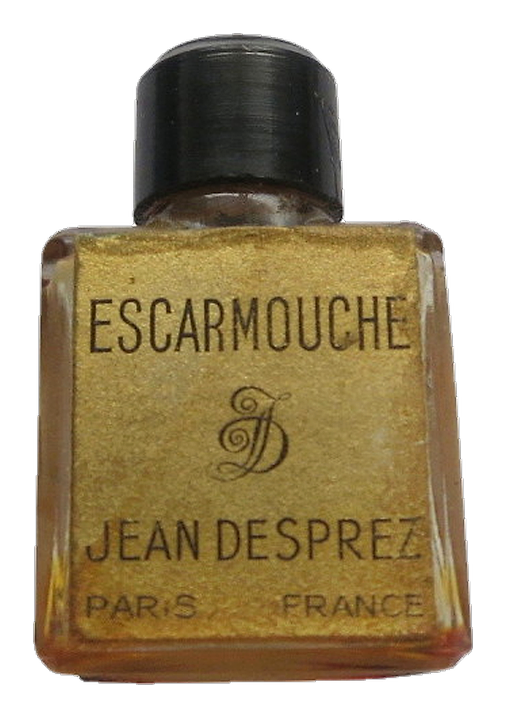
Escarmouche arrived in 1949 from Jean Desprez, the Paris house that had spent two decades making fragrances with names like Etourdissant and Jardanel, compositions that preferred character over comfort. The name itself carries a whiff of conflict: escarmouche means skirmish, a small tactical battle. Whether that refers to the wearer's disposition or the fragrance's own sharp-edged floral structure remains deliciously unclear. What is certain is the bottle, a sword-shaped flakon in Baccarat crystal, brass cap, black label, multi-colored tassel. This was not a fragrance designed to sit quietly on a vanity.
The sword flask says something important about Jean Desprez in 1949: the house was still thinking visually, still collaborating with artists and craftspeople in ways most perfume houses weren't. The composition inside that remarkable vessel leans floral, though which specific florals remain part of the fragrance's quiet mythology. What's notable is the arc: an opening that announces itself, followed by something softer, warmer. The skirmish gives way to surrender. That's the structural tension worth understanding, not a linear floral, but one with a genuine turn.
The evolution
On skin, Escarmouche opens with a crispness that reads almost green, almost citrus, the kind of floral freshness that smells like morning light through lace curtains. Within the hour, it warms. The powdery register emerges, soft and intimate, as if the sharp botanical edge has been folded away. By the third hour, you're in the drydown: a quiet, skin-close warmth that doesn't shout but stays. The sillage is moderate, this isn't a fragrance that announces itself across a room. It's the kind of scent you catch when someone leans close, and you're left wondering what it was.
Cultural impact
Escarmouche emerged in 1949, a period when post-war French perfumery was experiencing a creative renaissance. The sword-shaped Baccarat crystal flask represents a bold design departure from the conventional bottles dominating the era, signaling Jean Desprez's willingness to challenge aesthetic norms. This design choice positioned the fragrance as both scent and sculptural object, reflecting the post-war desire for luxury that was also distinctive and memorable. The house itself, founded in 1928, was building its reputation with compositions that balanced tradition with innovation. Jean Desprez's small workshop model meant each fragrance received careful attention, and the survival of Escarmouche as a collector's item today speaks to its distinctiveness.