The Story
Why it exists.
The beginning
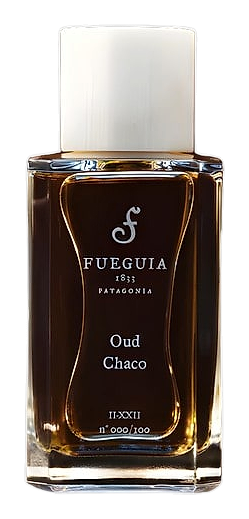
Oud Chaco comes from Julian Bedel's ongoing project with the Gran Chaco, a vast stretch of alluvial plains and dry forest straddling Argentina, Paraguay, and Bolivia. Bedel conducted botanical explorations throughout the region, documenting its biodiversity and considering what aromatic contribution its landscape might offer beyond the conventional sources most perfumers draw from. What emerged from that inquiry was a different kind of wood fermentation, one rooted in the South American context rather than the Aquilaria trees of Southeast Asia. Launched in 2022 as part of the El Mundo de los Ouds collection, the fragrance reframes what oud can be when it doesn't come from where everyone expects.
The unusual move here is material. Instead of agarwood, Fueguia 1833 ferments regional South American woods to produce an oud-like profile, a complete novelty in the universe of perfumery. The result carries the smoky, resinous depth that draws people to oud without the barnyard intensity many associate with traditional expressions. Musk rounds out the composition, giving it that second-skin warmth that makes the scent feel lived-in rather than performed. The contrast between familiar oud character and unfamiliar origin is the whole point.
The evolution
The first 15 minutes are the most challenging, not because anything's wrong, but because the fermented woods read almost like a savory reduction. Smoky, a little sharp, faintly animalic in a way that's more dry scrub than barnyard. If you know traditional oud, this opening will feel like a cousin speaking a different dialect. Around the 30-minute mark, the musk starts to assert itself, and the composition shifts from confrontational to enveloping. The smoke doesn't disappear; it deepens, getting warmer and slightly sweeter, almost like the wood has been breathing against skin. By hour two, you're in a quieter register. The sharp edges have rounded, and what's left is a dense, skin-close warmth that reads more like dark amber than raw wood. On fabric the next morning, it lingers as a faint, smoky sweetness, the kind of trace that makes you check your own sleeve.
Cultural impact
Oud Chaco walks a different line: it uses oud as a concept rather than a literal material, produced through fermentation of South American woods. Most wearers know oud as a Middle Eastern or Southeast Asian material, something expensive, sometimes divisive, almost always associated with specific cultural regions. This fragrance takes that tradition and reroutes it through entirely different raw materials, creating something that engages with oud's sensory language without inheriting its usual geographic sourcing.