
The Story
Why it exists.
The beginning
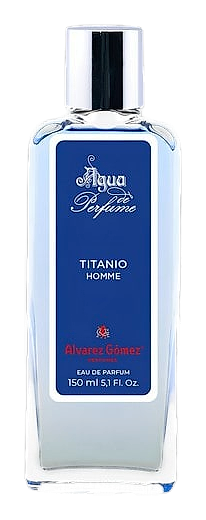
Titanio Homme arrived in 2021 as Alvarez Gómez's entry into the modern masculine aquatic space, a category the house had watched others dominate while holding firm to its concentrated cologne heritage. The name, Titanio (Titanium), signals intention: strength without weight, durability without aggression. Where other Spanish houses chased projection numbers, Alvarez Gómez built something meant to last a full workday without announcing itself. The brief was clear, marine freshness anchored by something warmer underneath, so the wearer never smelled like they were trying.
What makes this composition work is the jasmine. In most aquatics, white florals appear as afterthoughts, a softening agent for the marine accord. Here, jasmine is the structural choice. It doesn't gentle the salt; it argues with it. The bay leaf amplifies that tension, herbal, slightly bitter, the olfactory equivalent of green growing at the water's edge. The ambergris in the base doesn't read as animalic so much as warm, a fixative that keeps the marine accord from evaporating entirely. Patchouli provides the ground. Spanish citrus opens the conversation. The result is a fragrance that smells like the hour after a swim, not during, after.
The evolution
The opening is all citrus and marine, cold, bright, almost clinical. Think bergamot zest on salt water. No warmth yet. Around the 15-minute mark, the bay leaf arrives, green and slightly spicy, cutting through the citrus like a breeze through curtains. Then the jasmine emerges. It doesn't announce itself. It simply occupies the space the citrus vacates, soft and present, the unexpected guest who belongs. By the 45-minute mark, the marine accord has settled into something skin-like, warm salt instead of cold sea. The drydown belongs to the ambergris and patchouli. The jasmine fades last. On fabric, this lingers overnight. On skin, expect eight to ten hours before it becomes a memory you have to lean in to catch.
Cultural impact
Titanio Homme arrived at a moment when the Spanish fragrance landscape had grown crowded with European imports and celebrity releases. Alvarez Gomez, a house founded in 1899 and long associated with traditional Spanish concentration formats, needed to signal contemporary relevance without abandoning its heritage positioning. The marine aquatic genre offered the perfect vehicle: globally popular, commercially viable, and suited to the Mediterranean climate where the brand's customer base lives and socializes. What makes this launch culturally significant is not novelty but strategy. Rather than chasing niche positioning or breaking from house codes, Alvarez Gomez entered the modern masculine market by adapting established house strengths.