
The Story
Why it exists.
The beginning
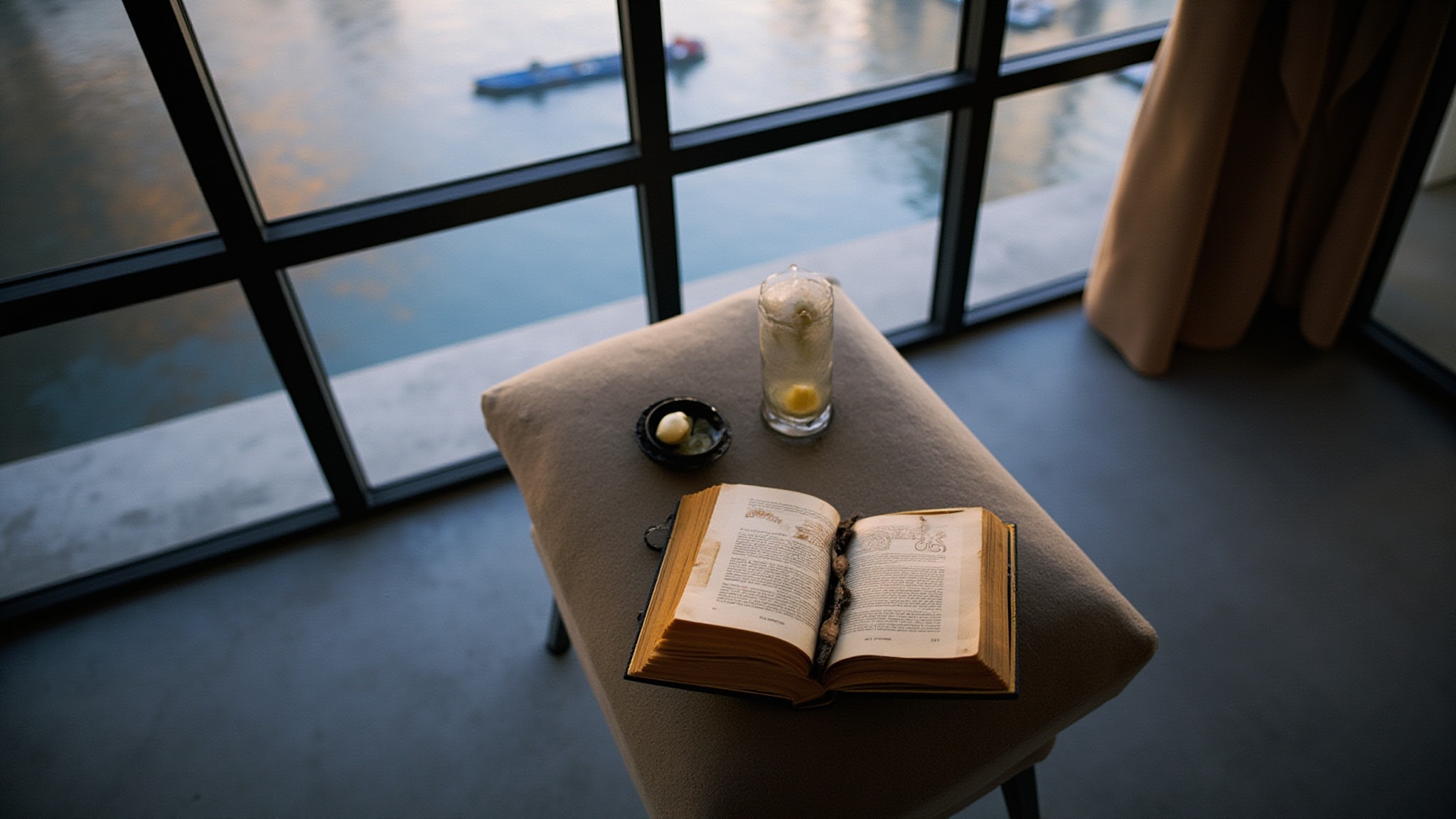
The name arrives from W.B. Yeats' 1928 poem, a meditation on art, mortality, and the desire to preserve beauty beyond the body. In Yeats' vision, Byzantium represents the place where the soul escapes the decay of age by surrendering to art. Alkemia's interpretation translates that longing into scent: a composition built around the artifacts of a life lived with intention, dried botanicals pressed between pages, leather worn soft from use, ink that has recorded decades of thought. Sharra Lamoureaux didn't set out to bottle a poem. She set out to bottle the objects a person might carry on a final voyage toward somewhere timeless.
What makes this structure unusual is the tension between aquatic freshness and aged materials. Most leather-and-ink compositions lean heavy from the start. Here, the bergamot-adjacent coolness of the lavender and the aquatic accord arrive first, almost clinical, almost cold. Then the leather enters not as a statement but as a correction. The oakmoss doesn't green the composition so much as ground it, giving the lavender something to rest against. The lotus root is the quiet surprise: a faintly starchy, aquatic-floral note that bridges the top and heart in a way that feels organic rather than constructed. It's the kind of middle note that most wearers don't identify by name but feel as a sense of coherence.
The evolution
The opening arrives crisp. Provence lavender meets green cardamom, herbal, slightly biting, with an aquatic undertone that reads as cool rather than marine. Think sea mist over a stone harbor, not pool chlorine. This phase holds for roughly thirty minutes before the leather announces itself, not loudly but with authority. The ink note appears here too, dry and slightly bitter, like a fountain pen uncapped in an old study. Oakmoss follows, adding a mossy green depth that softens the sharper edges. The heart settles into a quiet rumination: incense smoke curling through the composition, warmed by tonka bean's faint sweetness. By hour three, the drydown emerges, papyrus, wool, and the softest leather imaginable. The sillage has moderated to something intimate, close to the skin. It stays there for another three to four hours. The next morning, faint traces of oakmoss and paper remain on fabric, like a jacket left in a library.
Cultural impact
Part of Alkemia's Celtic Twilight Collection, Sailing to Byzantium occupies a specific niche: the fragrance for someone who reads poetry, keeps a journal, and finds more comfort in old libraries than new releases. It doesn't shout. It doesn't trend. It accumulates meaning slowly, the way the best books do. Wearers tend to describe it as the scent of a person who doesn't need to be noticed, which, in a market full of performance fragrances, reads as a quiet act of resistance.