The Story
Why it exists.
The beginning
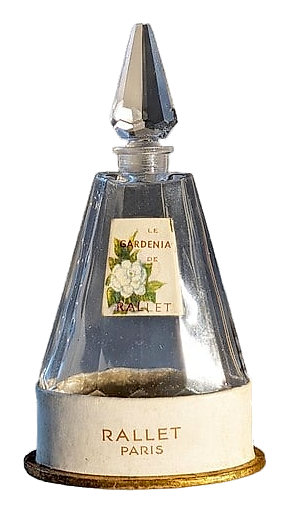
Le Gardenia de Rallet arrived in 1920, the work of Ernest Beaux during his years at the Moscow house. Beaux would later reshape fragrance history with Chanel No. 5, but here, at Rallet, he was working in a different register: a single-flower soliflore built around gardenia, the sort of composition that trusts one ingredient to carry everything. The composition holds its gardenia front and center, refusing to dilute the bloom with competing accents. There's a clarity to the way the note is presented, almost like a portrait rendered with limited palette but exacting hand. Beaux allowed the gardenia to occupy the full space of the fragrance rather than tucking it into a larger arrangement, and that decision gives the scent its singular character. The result is neither austere nor decorative.
What gives Le Gardenia de Rallet its particular gravity is the way the gardenia dominates without overwhelming. Just gardenia in its full register: creamy, waxy, slightly green, with that indolic undertone that gives white florals their pulse. The composition trusts the flower to do its own work, and the flower obliges. The scent reads as deliberate in its restraint. The lactonic warmth carries the base of the composition while a quiet supporting structure keeps the gardenia from collapsing into pure sweetness.
The evolution
On skin, Le Gardenia de Rallet opens with gardenia's brightest face: waxy, lanolin-rich, almost soapy in its cleanliness. The opening feels cool, white, and almost vegetal at the edges where the green notes of the stem show their hand. It is the gardenia at its most pristine, before the warmth of skin and time begin to shift the picture. As the fragrance develops, the indolic warmth begins to surface. The gardenia loses its soap-clean edge and picks up something more human, more intimate. The cream deepens. What was a flower becomes something worn on skin: warmer, more personal, less precious. The transition is gradual, almost geological, as the cool bright opening gives way to a softer, rounder interpretation of the same bloom. By the later hours, the gardenia settles into a quiet drydown.
Cultural impact
Le Gardenia de Rallet holds a quiet but meaningful place in early 20th-century perfumery. Composed by Ernest Beaux in 1920 at the Moscow house of Rallet, it stands as a single-flower soliflore from a period when such compositions held serious standing within the fragrance world. The fragrance reflects Beaux's approach to florals, treating gardenia as the central material of the composition rather than as one element among many. Though overshadowed by his later Chanel creations, Le Gardenia de Rallet remains a point of reference for those interested in Beaux's development as a perfumer.
The House
RalletRallet stands as one of the oldest continuously reimagined fragrance houses in the world, founded in Moscow in 1843 by French perfumer Alphonse Rallet. What began as a modest Parisian-trained atelier supplying Russia's imperial court grew into the nation's most celebrated perfume house by the turn of the twentieth century. After decades of silence, Rallet has been resurrected, bringing its extraordinary archive of historical formulas back into the hands of contemporary fragrance lovers.
The Creator
Ernest BeauxBeaux mastered the use of aldehydes at levels that created a luminous, almost effervescent quality previously unseen in perfumery. He combined the finest natural materials with synthetic innovations, particularly aldehydes, to produce compositions that felt both familiar and s…