The Story
Why it exists.
The beginning
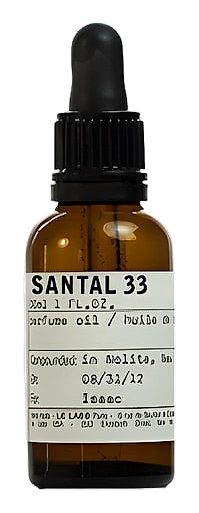
Frank Voelkl created Santal 33 in 2012 when Le Labo was still that downtown secret, the Nolita shop where bottles were blended by hand and labeled in front of you. The brief wasn't to make a crowd-pleaser. It was to make something that felt true. Santalwood as a material had been polished, softened, sweetened into submission by decades of mainstream perfumery. Voelkl wanted to go the other direction, back to the wood itself, with its grain and its character intact. The number 33 wasn't a statement. It was just where the formula landed. What happened next wasn't planned.
Australian sandalwood carries a different energy than its Indian counterpart, leaner, slightly medicinal, with a cedar-adjacent dryness that most perfumers find harder to work with. Le Labo's choice to build Santal 33 around it was deliberate. Pair that with leather and papyrus, both materials that smell like the absence of sweetness, and you get a fragrance that refuses to comfort on command. The violet and iris don't soften it so much as complicate it. And ambroxan, the signature drydown material, gives it that skin-close warmth that turns a fragrance into a memory.
The evolution
Cardamom hits first, bright, almost biting. Then violet arrives, powdery and cool, pulling the composition toward something more abstract. The transition doesn't announce itself. One moment you're in the opening, the next you're somewhere else entirely. The heart is where Santal 33 earns its reputation. Leather and papyrus arrive together, dry, slightly animalic, the smell of old paper and worn saddles. Cedar deepens everything without sweetening it. This is not a polite phase. It sits close to the skin and demands nothing from the room. By hour three, the ambroxan takes over. Violet and sandalwood settle into something powdery and warm, intimate in a way the opening never promised. It doesn't project. It lingers. The next morning, there's a trace on the collarbone that smells less like a fragrance and more like something that already belonged.
Cultural impact
Santal 33 became the defining fragrance of a certain New York creative class, the kind of people who find beauty in raw materials and handmade things over packaging. It shaped how a generation thinks about niche perfumery: not as luxury statement, but as identity. The perfume oil format made this cultural cachet feel even more personal.