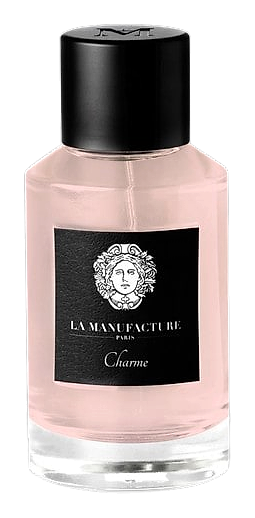

The Story
Why it exists.
The beginning
Charme takes its cue from Villa Balbiano on Lake Como, an Italian estate where gardens spill toward water and elegance is simply the default setting. The brief was to bottle that atmosphere: a walk through flowering grounds, refined and unhurried. Rather than building complexity for its own sake, the composition centers on three notes, blackcurrant, pear, and peony, each chosen for what it contributes to a coherent mood rather than what it adds to a list. The result is a fragrance that feels like a place, not a concept.
Blackcurrant brings a tart darkness that prevents the composition from becoming simply sweet. Pear offers juiciness without heaviness, it sits between fruit and water, bright without sharpness. Peony is the structural choice: lush enough to carry the heart of the fragrance, smooth enough to let the other notes breathe. The three together create a fruity-floral that reads as coherent rather than layered. There's no jarring transition between phases because the materials were chosen to feel like they belong together from the start.
The evolution
The opening lasts only a few minutes, a flash of citrus-laced pear, blackcurrant arriving immediately behind. Then the peony takes over. Not gradually. It arrives and it dominates, turning voluminous and silk-smooth within fifteen minutes. The blackcurrant deepens here, almost jammy without ever losing its freshness. Hours two through five belong to the heart. The peony softens but doesn't retreat, it lingers beneath everything, keeping the composition from going flat. By hour six, the drydown announces itself as a warm cedar presence, quiet and clean. The peony never fully disappears. It stays close to skin, intimate rather than announced, right up until the fragrance fades to nothing around hour seven or eight on most skin types.
Cultural impact
Charme arrives in 2023 as part of a house that treats fragrance like architecture, not narrative. It doesn't arrive with a story demanding to be believed. The Villa Balbiano reference gives it a context, an atmosphere to inhabit rather than explain. Among its fruity-floral peers, the pear-peony combination carves a distinct signature: softer than rose-heavy florals, less aquatic than most fresh compositions, warmer than green fragrances. It occupies a specific register of refined ease that the sources describe as elegant, joyful, and modern. Whether that register has cultural resonance beyond personal taste is, for now, still being written.