The Story
Why it exists.
The beginning
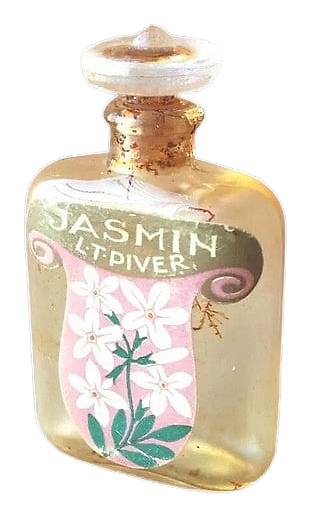
1927 was an era when perfumers still had something to prove with a single flower. L.T. Piver, a Parisian perfume house with deep roots in the old French tradition, released Jasmin as a statement of focus and restraint. The fragrance asked jasmine to carry the entire composition on its own, no blending, no masking, just the raw character of one bloom rendered with care. Discontinued now, but a clear signal of how the old French houses approached florals before the era of complex compositions: one note, done right, let it speak for itself. The name itself was a promise, and the juice inside delivered on it without apology or ornament.
A soliflore is harder to build than a composition with a dozen notes. There's nothing to hide behind. L.T. Piver's approach here leans into jasmine's full spectrum, the bright white sweetness most people expect plus the indolic, almost fecal depth that makes the flower smell alive rather than decorative. Strip away the green leaves, the citrus lifts, the woody bases that usually prop up a jasmine soliflore, and you're left with the flower itself, honest and slightly unruly. The perfumer has chosen not to round off the edges, not to cushion the bloom with supporting accords.
The evolution
What arrives first is jasmine at its most deceptively clean. The opening reads almost sparkling, the way fresh jasmine smells in morning light before the heat draws out the heavier compounds underneath. Once the indole starts climbing, the warm, slightly fecal undertone emerges, the note that makes natural jasmine smell human rather than pretty. The middle hours settle into a creamy, waxy white floral that sits close to skin. There's no base to speak of because there's nothing to change into. The jasmine simply softens and disappears rather than transforming. What lingers is a faint trace of warm floral on whatever fabric it touched, the ghost of a single flower rather than a complex composition. The drydown feels like watching the bloom exhale its last breath, gradual and quiet, leaving behind a memory more than a statement.
Cultural impact
Jasmin sits in the company of early 20th-century single-flower statements, the kind of releases that perfume houses put out as exercises in craft before layered compositions became the norm. It belongs to an era when French perfume was still willing to let one ingredient carry an entire bottle, trusting the perfumer's restraint and the flower's character to do the talking. The fragrance captures a moment in olfactory history when simplicity wasn't a limitation but a point of pride. Today it reads as a document of that philosophy, a reminder that the old houses once believed one flower, properly rendered, was enough.