
The Story
Why it exists.
The beginning
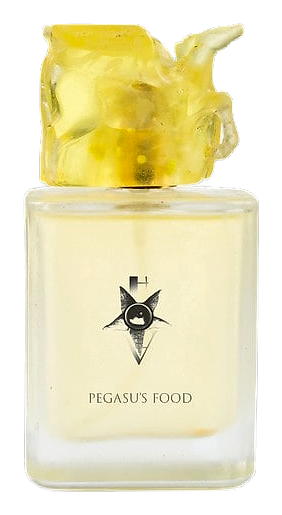
Pegasus's Food takes its name from the mythological winged horse, divine creature, impossible appetite. The title feels both whimsical and strange, which is entirely the point for a house that names fragrances like conversations overheard mid-sentence. Perfumer Elisabeth Andrék built the composition around an aldehydic opening and camphor note that immediately separates it from conventional fruity florals. The fragrance asks something of the wearer: attention, patience, a willingness to follow an unusual thread.
The aldehyde-camphor duo is the structural oddity here. Aldehydes can read as retro-chic or sharp, Chanel No. 5 made them legendary, but camphor is more commonly found in aromatics and folk medicine than in fine fragrance. Their combination creates a top note that is neither purely sparkling nor purely medicinal, but something with its own distinct character: clean, cool, almost clarifying. Against this, the hyacinth-lemon pairing offers green floral brightness, but the camphor reshapes how both register on skin. It's the note that makes Pegasus's Food harder to predict than its fruity heart suggests.
The evolution
The aldehydes announce themselves first, bright, almost metallic, a brief flash of light before the scene fully assembles. Lemon arrives alongside, sharp and immediate. Then camphor settles in, and this is where reactions split. On some skin it reads as cool and clarifying. On others it leans medicinal, like vapor rub on warm skin. Either way, it's the camphor that dominates the first twenty minutes, reshaping every other note that follows. Hyacinth emerges as the aldehydes begin to soften. Its green, slightly bitter floralcy takes over the conversation. Peach slips in quietly, not a primary character but a supporting one, adding sweetness that keeps the camphor from becoming too austere. The anise follows, unexpected and deliberate. It doesn't overwhelm but adds an aromatic twist that pulls the composition away from straightforward fruity-floral territory. The drydown is where oud and Cabreuva do their work. Dark resinous wood meets the sweeter, almost coconut-like warmth of Chinese Magnolia.
Cultural impact
Pegasus's Food arrives in a 2024 fragrance landscape where niche perfumers increasingly reject mainstream conventions. House of Atropa exemplifies this shift, producing fragrances with deliberately unusual titles that refuse easy categorization. The camphor-aldhehyde opening signals a commitment to radical self-expression over commercial appeal, positioning the fragrance as an artistic statement rather than a crowd-pleaser. House of Atropa's dual practice of perfumer and glass designer Elisabeth Andrék producing both scent and vessel reflects a broader movement toward art-world crossover in niche perfumery.