The Story
Why it exists.
The beginning
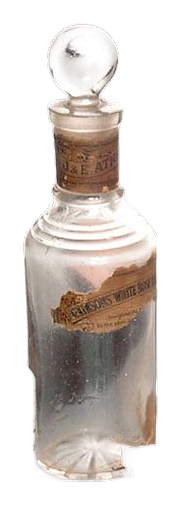
White Rose arrived in 1860, early in Atkinsons' history. This particular creation staked out different territory: a composition built on the white rose, delicate in a way that rewards attention. It became, according to the brand's own notes, the signature scent of Empress Aleksandra Fedorovna of Russia, born Alix of Hesse and of the Rhine. Her bespoke bottle of White Rose sat beside her at Tsarskoe Selo. The palace is gone. The fragrance, somehow, isn't. Her bottle is now housed in the Tsarskoe Selo Museum, preserved as a relic of a vanished court. There's something quietly remarkable about a scent that travels from a private dressing table to a museum vitrine across more than a century and still smells like itself.
What makes White Rose structurally interesting is its restraint. White rose at the center, Bergamot for a thin blade of light at the opening, Musk for the skin-warm envelope, and powder to pull it all into that old-fashioned softness. It's a four-note architecture that trusts each material to do exactly one job. The powder note is what separates it from a hundred other white rose attempts: instead of reading clean or green, the composition tilts toward the cosmetic, the talcum, the sachet drawer.
The evolution
The opening is brisk and almost clinical. A thread of Bergamot cuts through the white rose for the first ten minutes, giving the composition its only moment of sharpness. Then the citrus steps back and the rose takes over, full and unapologetic. The rose blooms into something dense and slightly soapy, the way a freshly cut stem might leave a faint lather on the fingers. Around the two-hour mark the Musk surfaces, and the fragrance begins to lose its floral definition. What replaces it is warm, soft, and close to skin. The powder note intensifies rather than fades, which is unusual, deepening into a soft cosmetic haze as the hours pass. By hour four you're wearing something that smells less like a flower and more like the memory of one: talc, warm fabric, the faintest trace of soap.
Cultural impact
White Rose carries a specific kind of historical weight that most fragrances never achieve: it was the personal scent of a Romanov empress, and her bespoke bottle now lives in the Tsarskoe Selo Museum. That single detail does more to shape how people approach the fragrance than almost anything else about it. The scent has the quality of an object pulled from a vitrine, something preserved rather than reinvented. Its closeness to museum culture gives it a peculiar gravity. The fragrance doesn't read as a contemporary launch, and that's part of its draw for anyone interested in the older traditions of perfumery.