The Story
Why it exists.
The beginning
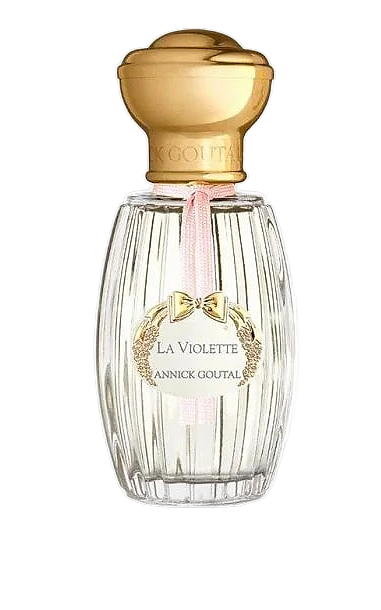
La Violette belongs to the Goutal Soliflores collection, fragrances built around a single flower, treated with the patience of a portraitist rather than the efficiency of a formula. Released in 2001, it arrived when Isabelle Doyen and Camille Goutal were deepening their collaboration, moving the house toward compositions that felt less like perfume and more like memory. The violet presented a particular challenge: it is beloved in theory, often disappointing in practice. Synthetic recreations tend toward cough-sweet or talcum powder, losing the green, living quality of the actual flower. Doyen and Goutal approached the problem structurally, using violet leaf as both opening and anchor, not just the flower, but its stems, its green reality. The result is a soliflore that behaves like a plant, not a concept.
The architecture of La Violette is deceptively simple: violet leaf opens, violet leaf closes. This circularity is the point. Where most soliflores move in a straight line, bright start, fading middle, negligible end, La Violette folds back on itself. The green that opens the fragrance returns in the base, though transformed: warmer, softer, closer to powder than stem. The Turkish rose does not compete with the violet; it inhabits the same space without hierarchy. The raspberry appears briefly, a shimmer of sweetness that could be missed if you are not paying attention. You should be.
The evolution
The opening arrives green and immediate, violet leaf at its freshest, still damp from the morning. There is something almost mineral about it, a petrichor quality that grounds what could otherwise float into abstraction. This phase lasts perhaps thirty minutes before the raspberry surfaces, a brief sweetness, a flicker. Then the heart opens: Turkish rose, not heavy damask but something lighter, almost tea-like. The violet recedes here, becoming powder rather than fresh petal. The green fades slowly, giving way to something warmer. By hour three, the drydown has settled into a quiet violet powder, the kind that clings to skin rather than room. The Turkish rose lingers at the edges, faint and refined. What remains is the memory of a flower held too close: intimate, slightly sweet, impossible to describe to someone who has not smelled it.
Cultural impact
The soliflore tradition runs deep in classical perfumery, though it fell out of fashion as complex, multi-layered compositions became the norm. Violet soliflores carry particular baggage, they recall vintage formulations, nostalgic grandmothers, the talcum powder of another era. La Violette arrived in 2001 as a rebuttal to that association. This is not a relic. It is a contemporary violet soliflore that refuses to be dated or aggressively modern. The fragrance attracts those who have moved past complexity as a measure of quality, wearers who understand that restraint requires confidence. It performs best in spring and cooler weather, though it carries through most seasons without strain.