
The Story
Why it exists.
The beginning
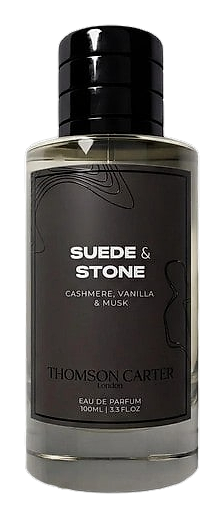
Suede & Stone arrived in 2026 as part of Thomson Carter's growing catalog. The house built its reputation on scents that read like personal narratives, and Suede & Stone lands squarely in that tradition. The brand's own description names its intent plainly: the morning after a good night. Warm skin, clean sheets, and someone worth remembering. It isn't built for the entrance. It's built for what stays after you leave. The three-note structure keeps it disciplined. Cashmere wood opens, vanilla settles at the center, and white musk carries the long quiet of the drydown. There's a deliberate minimalism here that says a lot about what the fragrance is trying to do. Rather than stacking accords or chasing complexity, it leans into a small palette and lets each component speak.
What makes Suede & Stone interesting is what it leaves out. There's no spice stack, no oud anchor, no projection-boosting aromachemicals doing heavy lifting. The composition trusts softness. Cashmere wood gives it a tactile, almost-fabric feel from the first minute, while vanilla skips its usual gourmand sweetness and behaves more like warm skin than like dessert. White musk finishes the job, clean and close, like laundry that hasn't quite finished drying. For a fragrance aiming at the 'morning after' register, restraint matters more than complexity.
The evolution
On skin, Suede & Stone doesn't so much evolve as soften. The opening is cashmere wood with a dry, slightly mineral warmth, more textile than cologne. Within ten minutes, vanilla arrives, but quietly, more like body heat than like a flavor. It rounds the edges without adding sweetness for sweetness's sake. The heart sits close to the skin for most of the wear, and the white musk takes over in the later hours, giving the composition a clean, almost-soapy softness. The fragrance behaves like a private thing, something you catch in passing rather than something that announces itself. As the cashmere wood fades, its dry character gives way to the vanillic warmth, and the transition feels seamless in the way a held breath becomes a sigh. The musk that eventually dominates isn't sharp or laundry-detergent clean; it's closer to the scent of skin after a shower, warm and faintly powdered.
Cultural impact
Suede & Stone sits in a current of soft compositions that have resonated with fragrance communities online. Wearers describe it as the kind of scent that doesn't need an event to justify itself. It reads closer to skincare than to cologne, which suits the fragrance's stated register. Its cashmere-wood opening gives it a drier, more textile character than most, and that tactile quality is part of what sets it apart. The fragrance doesn't perform for a room; it performs for the wearer, and that distinction has helped it find an audience.