The Story
Why it exists.
The beginning
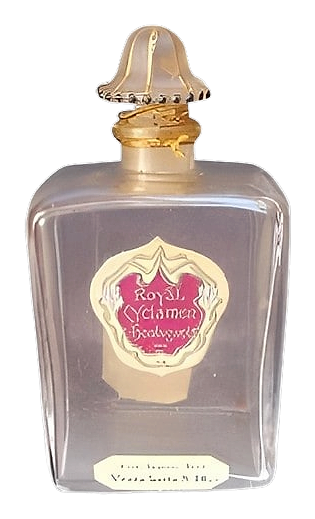
Royal Cyclamen arrived in 1920 from the house of Houbigant, a Parisian perfumer whose name carries considerable weight in French fragrance history. By the early twentieth century, Houbigant had established a distinctive catalogue that helped shape the direction of modern French perfumery. The cyclamen itself is a demure bloom, its swept-back petals carrying the muted hue of pale wine, a flower that seems made for quiet observation rather than bold display. Royal Cyclamen was built around that quietness, a fragrance made for women who wanted their perfume to whisper rather than declare, a mood as much as a scent. The composition takes its subject with seriousness, treating the bloom as the singular focus of the work.
What sets Royal Cyclamen apart from many of its contemporaries is its discipline. Where other florals of the era piled blossom upon blossom into elaborate constructions, this composition stays restrained, nearly monofloral in its approach. The cyclamen note carries the whole weight of the fragrance, and it carries it with remarkable poise. There is a coolness to it, a green-edged clarity that reads as both floral and slightly aquatic, closer to the scent of a single stem held up to the light than to any mixed bouquet.
The evolution
The opening arrives cool and almost mineral, a green-tinged lift that settles within minutes into the true cyclamen heart. That heart is the longest phase: a pale, watery floral that hovers close to skin, neither projecting far nor fading fast. It carries through the first several hours with remarkable steadiness, shifting from cool to slightly warmer, almost creamy, as though the petals have warmed in a closed hand. The transition from opening to heart is gentle but distinct, a softening of the cool green edge into something more rounded and intimate. As the hours pass, the floral character gradually recedes, leaving behind a quiet trace that clings to fabric with a softness that feels almost spectral. The composition rewards patience, unfolding slowly and revealing different facets at each stage of its wear.
Cultural impact
Royal Cyclamen occupies a distinctive place among early-twentieth-century florals, a composition that treated a single bloom with the seriousness often reserved for more elaborate constructions. It appeals to collectors of vintage French perfumery and to wearers who want a scent that reads as a portrait rather than a statement. The fragrance has earned a quiet following among those who value restraint and classical execution in perfumery, and it remains a touchstone for the cyclamen soliflore tradition.