
The Story
Why it exists.
The beginning
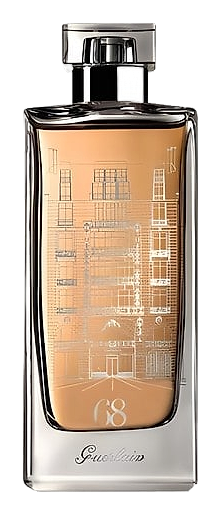
The name says it all. Le 68 is a reference to the Guerlain flagship, the historic Paris address that has defined the house for generations. Thierry Wasser designed this fragrance as a wearable portrait of that place, its quiet confidence, its particular warmth. Launched in 2013, it arrived as a counter-statement to the era's louder fragrances. Not louder. Truer. The composition unfolds with an almost tactile softness, each note arriving without announcement, settling into skin like a well-worn secret that never needed telling. There's a studied ease to the way it moves through its stages, unhurried and deliberate, the work of a house that knows exactly what it is.
What makes Le 68 work is the immortelle. It brings a resinous, almost medicinal sweetness that sets it apart from more conventional florals. Here, it's paired with tonka bean's vanillic cream and benzoin's balsamic warmth, creating a heart that feels both soft and resilient. The leather and incense arrive with quiet confidence, threading through the composition to add structure without interrupting its essential softness. The overall effect is of something layered and contemplative, a fragrance that rewards patience as its notes unfold in careful sequence.
The evolution
It opens warm and slightly herbaceous, the immortelle asserting itself with a distinctive honeyed sweetness before settling into the tonka-benzoin embrace. Thirty minutes in, something shifts, the powder opens up, soft, almost edible. This is the phase people fall in love with. Two hours in, leather emerges quietly from beneath, not the sharp industrial kind but the warm, worn kind. Incense threads through the drydown like a suggestion rather than a statement. By hour six, you're left with a skin-close amber that smells like the ghost of the perfume you were wearing earlier in the day. Still there the next morning, if you're lucky. The sillage remains intimate throughout, never demanding attention but always present, a steady companion that grows more familiar with each hour.
Cultural impact
Le Parfum du 68 arrived in 2013 as a quiet counter-argument to a fragrance market leaning into loudness. It speaks to a certain kind of wearer, someone drawn to complexity without performance, warmth without sweetness, a fragrance that feels like earned knowledge rather than obvious statement. The composition itself seems to resist the shortcuts of conventional appeal, choosing instead to offer something that reveals itself slowly, generously, to those patient enough to receive it. It's never been a bestseller in the traditional sense, which is precisely what its wearers tend to love about it.
The House
GuerlainGuerlain stands as one of the oldest and most revered perfume houses in the world, founded in Paris in 1828 by Pierre-François-Pascal Guerlain. What began as a boutique on rue de Rivoli quickly became the preferred destination for Parisian society, attracting dandies and elegant women who sought custom-crafted fragrances. The house's influence grew to such heights that Guerlain earned the title of Official Perfumer to Napoleon III after presenting Eau de Cologne Impériale to Empress Eugénie as a wedding gift in 1853. This royal patronage marked the beginning of Guerlain's enduring association with European aristocracy, as the house went on to create fragrances for Queen Victoria and Queen Isabella II of Spain. Today, under the creative direction of Thierry Wasser, the fifth-generation perfumer, Guerlain continues to shape the landscape of fine fragrance with a portfolio spanning over 1,100 olfactory creations. The house remains headquartered at its legendary Champs-Élysées mansion, a historic monument that anchors Guerlain's position at the intersection of heritage and contemporary luxury.
The Creator
Thierry WasserWasser gravitates toward green, crispy notes and the bold florals Guerlain is known for. Bulgarian rose appears repeatedly in his work, and he travels annually to oversee the harvest in Kazanlak.