The Story
Why it exists.
The beginning
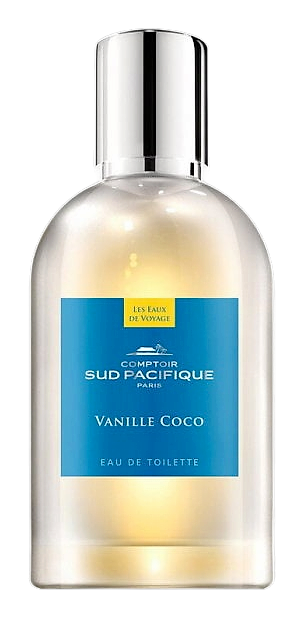
Launched in 2003 as part of Comptoir Sud Pacifique's Eaux de Voyage collection, Vanille Coco was built around a single edible fantasy: coconut and vanilla, dressed up just enough to feel like perfume rather than kitchen counter. The composition sits comfortably in the brand's tropical lane: escapism in wearable form, no apology attached. The name does the work. Vanille Coco is two ingredients and a mood, no mystery, no coded symbolism. It's a postcard from somewhere warm, written in coconut cream and Tahitian vanilla and sealed with a heliotrope stamp. The kind of fragrance that doesn't need a backstory because the scent is the story.
What makes the structure work is the restraint underneath all that sweetness. Heliotrope carries a marzipan-adjacent softness, but it also has a faintly dusty, almost powdery edge that keeps the composition from collapsing into pure sugar. It's the difference between a fragrance that smells like dessert and one that smells like someone who just finished dessert. The heliotrope's almond facet weaves through the coconut's cream like a thread of marzipan tucked into a pastry, adding chewiness and warmth without weighing the blend down.
The evolution
The first ten minutes smell like opening a jar of something rich. Heliotrope hits first, sweet and slightly herbal, almost licorice-adjacent in its warmth. Then the coconut rolls in, not as a suntan oil blast but as something quieter, milkier, the way coconut tastes after it's been cooked down with sugar rather than splashed on skin at the beach. By the thirty-minute mark, the Tahitian vanilla has fully taken over the composition's architecture. It's warm, almost boozy in its richness, and it does something most vanilla-dominant fragrances struggle with: it stays dimensional instead of flattening into a single syrupy note. The heliotrope retreats but doesn't disappear. It hovers underneath, giving the drydown a faint almond-bitter edge that keeps the sweetness honest. Six hours in, the coconut has softened into something that reads more like skin-warm vanilla than anything tropical. On fabric the next morning, it still smells like dessert, quieter now, but unmistakably there. The longevity holds better than the moderate sillage suggests.
Cultural impact
Vanille Coco sits in a specific niche: the gourmand fragrance that doesn't try to be anything other than what it is. It commits fully to the edible fantasy, which is exactly why it has a devoted following among wearers who want dessert without pretense. The fragrance doesn't dilute its central idea with smoky or bitter counter-notes, and it doesn't try to intellectualize the coconut-vanilla pairing into something abstract. Instead, it leans into the joy of those two ingredients, letting them speak loudly and clearly, and that confidence is part of the appeal.