
The Story
Why it exists.
The beginning
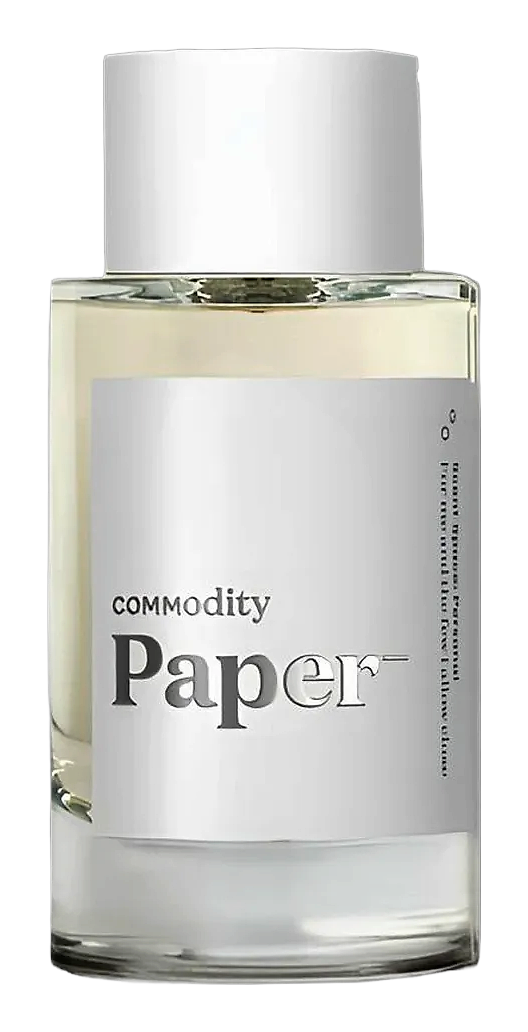
Paper arrived as part of Commodity's original collection, built around a single molecule: Iso E Super. The concept was simple. Make a fragrance that didn't smell like a fragrance, something abstract, molecular, and close. The brief was to translate the idea of paper, not its smell. Cedarwood, sandalwood, amber. Not paper. The abstraction of paper. A scent that smelled like the concept of a clean sheet, not the pulp itself. That's where the name came from. Not literal interpretation. Intellectual shorthand for something clean, minimal, and present. The scent moves slowly across the skin, evaporating in waves that feel more like atmospheric change than perfume. There's no sharp opening, no botanical announcement.
The interesting choice here is what the formula doesn't do. Most fragrances use Iso E Super as a supporting player, a fixative, a smooth operator in the background. Paper makes it the main character. The entire structure is built around it. Cedarwood, amber, and sandalwood exist to frame the Iso E Super, to give it warmth, to keep it from reading too sharp or too synthetic. The result is a fragrance where the molecule isn't hidden, it's celebrated. This is transparent in a way most niche formulas aren't. You smell exactly what they're doing, and they're doing it on purpose.
The evolution
The opening is Iso E Super in its cleanest form. Transparent. Almost abstract. A clean accord that reads as proximity, the sensation of something near your skin before it becomes scent. Within minutes, cedarwood arrives with warmth. Amber follows. Together they soften the sharp edge into something more natural, more intimate, the phase that gives Paper its character. Then sandalwood takes over. The drydown is cream and warmth, a skin-like quality that makes the fragrance feel less like something you applied and more like something you were born with. Close to the body throughout. That's the arc, clean, warm, skin. As the hours pass, the woody elements deepen slightly, the cedar becoming more pronounced while the sandalwood maintains its creamy presence. The amber doesn't disappear but instead integrates more fully, becoming part of the skin-like warmth rather than a separate layer.
Cultural impact
Paper occupies a specific niche in the landscape of molecular fragrances, finding a balance between complexity and restraint. The addition of cedarwood, amber, and sandalwood gives it more dimension than pure synthetic plays, while keeping it firmly in the skin-close, intimate category. The fragrance appeals to those who want scent to remain personal rather than performative. Some wearers find it disappears quickly, which can feel disappointing if projection is expected. Others discover in it a quality of closeness, something that becomes part of them rather than something they wear.