
The Story
Why it exists.
The beginning
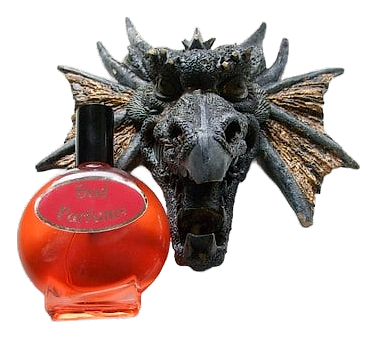
In 2017, Howard Jarvis dreamed of an enchanted redwood forest at night. Fog. Damp earth. A dragon watching from the shadows, its lair hidden somewhere in the mist. When the creature finally departed, three golden eggs remained in a nest of sticks and dry leaves. The dream was vivid enough to demand translation into scent. Jarvis set out to recreate not just a fragrance, but an atmosphere, the actual smell of a forest encounter with something ancient and territorial. The result became Wild Dragons Blood, a fragrance built around the resin known as dragon's blood, which when burned produces something dark, mysterious, and deeply smoky. He ground the hard crystals in a mortar and pestle, added ethanol, and incorporated the material directly into the formula. What began as a dream became an 8-10 hour study in resin, smoke, and the quiet dread of something watching from the dark.
The use of dragon's blood resin itself is the defining choice here. Sourced from Daemonorops palm species in tropical regions, this natural material carries a smoky, slightly sweet quality that behaves differently from synthetic smoke accords. Where a synth might project sharply and fade cleanly, natural resin smoke breathes and shifts across hours. Combined with frankincense, the same olibanum that appears in both sources, and labdanum's resinous, cistus-derived depth, the composition layers smoke upon smoke upon smoke. Cedarwood and oakmoss add the forest floor. Beeswax brings warmth closer to skin. Musk anchors everything in something animal, almost intimate.
The evolution
The opening is smoke. Not a suggestion of smoke, smoke itself, curling into the air like incense from a dragon's lair. Dragon's blood resin announces itself immediately, dense and dark, joined by frankincense that sharpens the effect. There's a sweetness underneath, beeswax perhaps, or benzoin bleeding through, but it takes a few minutes to surface through the haze. The cedar and oakmoss arrive next, cool and ancient, the forest revealing itself beneath the smoke. This is the phase that earns the fragrance its name, not just the blood of a mythical creature, but the smell of a creature's dwelling. Hours pass. The smoke doesn't disappear. It settles, deepening into something more animal. Beeswax, musk, patchouli. Benzoin's warmth grows closer to skin. On fabric, this fragrance lasts 8-10 hours easily, projecting strongly for the first three to four hours before softening to moderate sillage. The drydown is that rare thing, an animalic base that doesn't disappear. It lingers. It stays. The morning after, on skin and on fabric, a quiet smoky warmth remains.
Cultural impact
Wild Dragons Blood sits comfortably in the category of fragrances that don't care whether you like them. Made by an independent Australian house not bound by French perfumery conventions, it speaks to collectors who treat fragrance as provocation rather than decoration. The smoky, resinous, animalic character isn't for everyone, but for those who've ever wanted a scent that actually smells like something mythic, this is the rare fragrance that earns its name.