René Lalique
René-Jules Lalique was born in 1860 in the French village of Marne, a rural world on the cusp of industrial change. Apprenticed to a Parisian goldsmith at sixteen, he spent his early twenties freelancing in jewelry for Cartier, Boucheron, and other leading Parisian houses, opening his own studio before turning twenty-five. By the late 1890s, his name had become shorthand for the sinuous, nature-soaked flourishes of Art Nouveau, and Sarah Bernhardt herself counted among his admirers. Around 1907, Lalique pivoted decisively from metalwork toward glass, opening his own glassworks near Paris in 1909 and pioneering techniques that allowed for frosted, opalescent, and internally patterned surfaces. He went on to shape the visual language of early 20th-century French perfume, designing flacons for houses including Coty, Guerlain, Houbigant, Roger & Gallet, and Worth, eventually producing more than 250 bottle designs for the industry. He passed in 1945, but his imprint on perfumery's material culture survives in every collector's cabinet and in the crystal house his descendants still steward.
The hits
Notable creations
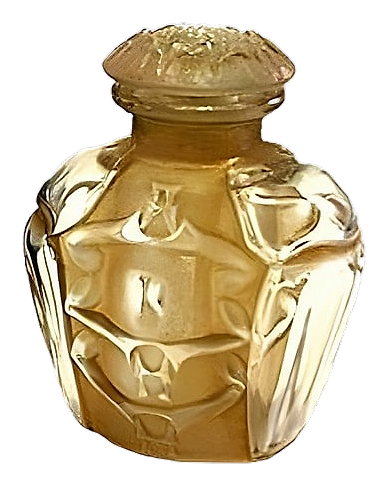
The signature
How René composes
Though better remembered as a designer and glassmaker than a nose, Lalique's influence on perfumery runs through objects rather than accords. His signature was texture: soft, sculptural, and unmistakably hand-finished, with frosted masts pressed into relief, milky opaline fading into clear crystal, and geometric stoppers that feel carved from cloud. He worked intimately with perfumers like François Coty's composer teams, translating scent concepts into vessels that anticipated the mood of the juice. Within a single commission he might employ patiné, cased, and cire-perdue glass in turns, treating each piece as a small theatre of light. The resulting flacons gave French perfumery its most enduring visual vocabulary, one collectors still revere a century on.
Philosophy
What drives René
Lalique approached the bottle with the seriousness most designers reserved for sculpture. To him, the flacon was no afterthought to the juice inside: it was an object meant to be held, lit, and lived with on a vanity long after the scent had faded. He chased the play of light through glass as other artists chased pigment across canvas, developing proprietary techniques for pressing, acid-etching, and moulding that gave his surfaces an almost living quality. Function and ornament were inseparable in his thinking; a stopper had to feel right in the hand, a label had to sit cleanly against a curve, a colour had to catch the morning sun. Luxury, for Lalique, was never noise. It was intention, material, and craft aligned.
The houses