Henri Rigaud
Henri Rigaud stepped into the world of perfumery through a door few expected. Educated in the south of France, he made his first moves in the Parisian business milieu before joining Rigaud and Chapoteaut during the 1890s, where his imagination and commercial instincts quickly set him apart. He assumed leadership of the house in 1910, shortening the company name to simply "Rigaud" and steering it into a new era of ambition. Under his direction, the maison expanded across borders, developing a range of perfumes tailored for European clientele as well as markets in the Middle East and beyond. Rigaud proved himself an innovator in packaging as well as scent. In 1917, he became the first perfumer to market face powder and rouge in an elegant oval-oblong case, a small detail that reflected his larger philosophy that presentation matters as much as composition. By the middle of the twentieth century, the Rigaud name had traveled the globe, cementing its reputation as a Parisian house with international reach.
The hits
Notable creations
The signature
How Henri composes
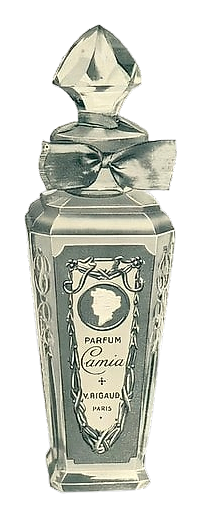
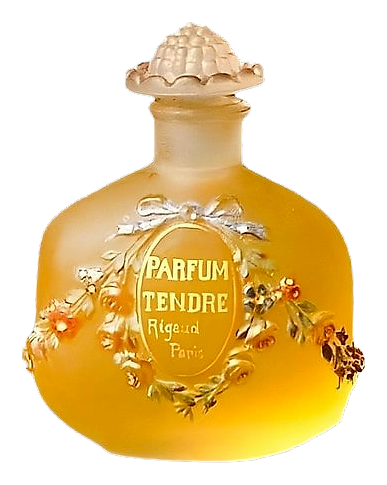
Rigaud built a signature rooted in classical French perfumery while remaining open to exotic influences sourced through international trade. His compositions leaned on rich, warm materials drawn from the South of France and from further afield, crafted to suit a global clientele. He showed particular interest in merging fine fragrance with wax and powder, treating scent as something to inhabit multiple formats. His preference for distinctive presentation, from oval-oblong powder cases to early scented candles, became a hallmark of the house. The result is a style that feels traditional yet adventurous, Parisian in its polish and worldly in its appetite.
Philosophy
What drives Henri
Henri Rigaud believed fine fragrance and beautiful presentation were inseparable. He treated each creation as a complete object, one meant to be admired on the vanity as much as worn on the skin. His early travels and commercial work gave him a sharp instinct for what different markets craved, and he used that sensitivity to build perfumes that felt at once distinctly Parisian and adaptable to distant shores. Innovation guided him constantly, whether refining a formula or reimagining the container that held it. For Rigaud, the scented candle, the rouge compact, the extrait bottle, each was an opportunity to bring a measure of artistry into everyday ritual. He approached perfumery as both craft and commerce, never losing sight of either.
The houses
Maisons Henri composes for
In the same league