
The Story
Why it exists.
The beginning
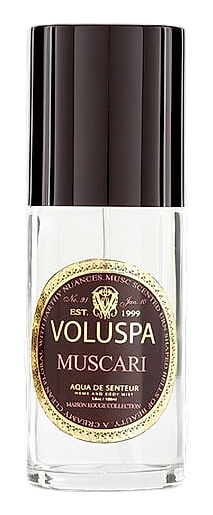
Muscari arrived in 2010 as part of Voluspa's perfume explorations, a release that signaled the brand's growing interest in crafting compositions meant for the skin rather than the air. The name carries a botanical resonance, one that hints at something floral and quietly familiar, though the fragrance itself takes liberties with that reference, bending toward the cool, dewy sweetness of petals gathered at the stem without aiming for literal reproduction. Cool and dewy on opening, the scent settles into a soft, powdery floral warmth that lingers like a whisper rather than a declaration. The top notes are bright and aqueous, almost reminiscent of morning condensation on glass, while the heart reveals a gentle, creamy floralcy that feels both modern and nostalgic.
What's interesting about Muscari is its restraint. With only floral notes and musk in the architecture, the composition commits to an idea rather than a catalog. There's no citrus to brighten, no wood to ground, no spice to complicate. Just petals and skin, layered until they become hard to separate. That minimalism is the whole point. A fragrance this stripped-down lives or dies on material quality, and on how the florals are blended into the musk so that neither dominates.
The evolution
Muscari opens soft, almost tentatively, like catching a scent through a closed door. The first thirty minutes are the most floral, petals at their freshest, slightly green at the stem, cool against skin. There's no sharp citrus to cut through, no aldehydes to shout. It simply arrives, quietly, and asks to be noticed. As the first hour passes, the musk begins to rise from underneath, warming the florals, pressing them closer to skin. The composition becomes less about flowers and more about warmth itself, the floral character softening into something almost amber-like without ever crossing into resin territory. By the three-hour mark, the distinction between floral and musk has dissolved entirely. What remains is a close, skin-warm haze that reads more like a feeling than a fragrance. On a sweater the next morning, it survives as a faint, clean trace, barely there, but unmistakable if you remember what you wore the day before.
Cultural impact
Muscari occupies a distinctive place within the Maison Rouge collection, a grouping that seems designed for those who prefer their fragrance felt rather than announced. The collection's approach favors intimacy over projection, creating scents that function as personal environment rather than public statement. There's a quiet confidence in this kind of composition, a willingness to let the wearer carry something private, something that reveals itself only in close quarters.



















