
The Story
Why it exists.
The beginning
When Prada wanted to make a fragrance called Candy, they turned to Daniela Andrier. Andrier doesn't do obvious. So a fragrance literally named after sugar became something stranger and more interesting than dessert. Launched in 2011, Candy introduced something unexpected from a house with a particular reputation. Andrier's answer was a composition built around three materials, each doing heavy lifting. White musk opens, a clean and almost soapy introduction that feels surprisingly restrained for a scent named Candy. Siam benzoin anchors the middle, bringing a resinous warmth that reads more golden than sweet. Caramel closes, thickening the air with a syrupy sweetness that doesn't quite behave the way you'd expect from something so literal. Nothing ornamental. Nothing wasted.
What makes the construction unusual is the restraint. Most gourmand fragrances stack vanilla, praline, chocolate, and enough sugar to fill a bakery. Candy does the opposite. It bets everything on a single caramelized note, a resin that smells like warm amber and powdered sugar, and a clean musk that keeps the sweetness from collapsing into cloying territory. The bet paid off. This is caramel stripped to its essence, held in place by something almost architectural. Andrier reportedly worked around her own anosmia to certain sweet materials, meaning she built a sugar bomb while being partially numb to sugar. The precision shows.
The evolution
On skin, Candy opens with a whisper of white musk, clean and almost soapy, the kind of bright freshness you'd expect from a morning shower. The musk gradually pulls the Siam benzoin forward, and the composition finds its center. There's a resinous, slightly vanilla-tinged warmth at the heart, a golden kind of sweetness that feels more atmospheric than edible. The caramel doesn't arrive so much as materialize, thickening the air without shouting. The result is a warm, sweet composition that stays anchored rather than spinning off into pure sugar. On skin the drydown settles into a single molten texture that softens gradually, the warmth staying close rather than projecting widely. The musk never fully disappears, which keeps the whole thing from feeling like spilled syrup, adding a clean undertone that grounds the caramel's richness.
Cultural impact
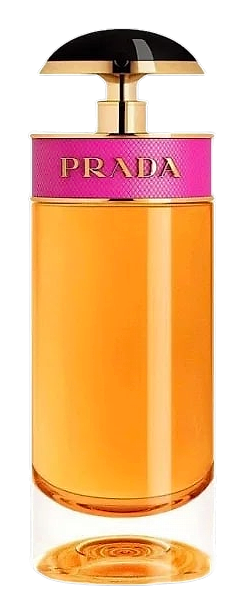
Candy earned attention beyond the usual fragrance press. The bottle, designed by Fabien Baron, was almost as talked about as the scent itself. It arrived as a release that invited conversation, with its bold color and confident finish standing apart from what people had come to associate with the brand. That contrast became part of the appeal. The fragrance inside matched the bottle's confidence, sweet but controlled, playful but deliberate. Candy occupied a space where it could feel accessible without being dismissed, approachable without being simple.