
The Story
Why it exists.
The beginning
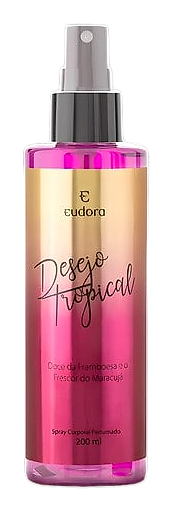
Desejo Tropical landed in 2018 as part of Eudora's rotating catalogue of fruit-driven and gourmand compositions. The Brazilian house, a standalone line from Grupo Boticário launched in 2011, built its identity on accessible, trend-aware scents designed for a younger, digitally native audience. Within that roster, Desejo Tropical stakes out the tropical end of the spectrum: a two-note heart that puts passion fruit and raspberry at the center without ornamentation. The intent reads clear in the name itself, "desejo" meaning desire in Portuguese. This is a fragrance built to evoke wanting something, and the something happens to be a Brazilian summer.
What makes the composition worth noticing is the restraint. Where most tropical launches pile on coconut, pineapple, and tiare to sell the fantasy, Desejo Tropical keeps the pyramid lean. Passion fruit brings a tart, almost vegetal brightness. Raspberry rounds the edges with a jammy sweetness that keeps the tartness from veering sharp. The result reads more like biting into fruit at a market stall than a curated cocktail. The Oriental Floral classification adds a rose undertone to the accords that isn't stated in the notes but gives the blend a softness underneath all that fruit sugar.
The evolution
The first thirty minutes belong entirely to passion fruit. It opens loud and unmistakable, almost sharp enough to cut through anything else you might be wearing. Raspberry joins quietly within the first hour, adding sweetness without taking over. By the second hour, the two fruits blur into one warm, slightly syrupy impression that sits closer to the skin. The tropical accord softens rather than fades. From hour three onward, what remains is a gauzy fruit sweetness, less defined, more atmospheric. On most skin types the scent stays present through hour five before thinning into a faint berry trace that lingers on fabric well into the next day.
Cultural impact
Desejo Tropical sits in a crowded field of tropical and fruit-forward fragrances, but its Brazilian context gives it a different register than most Western tropical launches. Where American and European tropical scents often lean cocktail-poolside, this one reads more like the fruit table at an open-air market. The rose undertone in its accord structure places it closer to Oriental Floral territory than straightforward fruity territory. Wearers who gravitate to it tend to want a warm-weather scent that doesn't try to be a gourmand or a floral. It also shares DNA with other Brazilian fruit-forward launches from Natura and O Boticário, though the restraint of a two-note heart makes it more defined than most.