
The Story
Why it exists.
The beginning
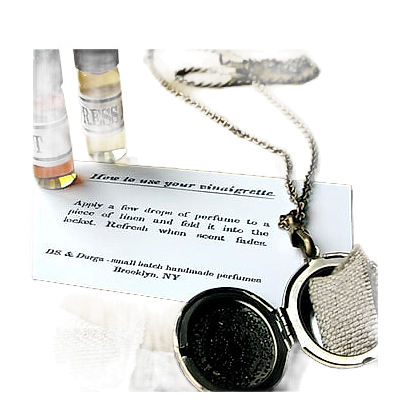
Empress Jingu takes its name from a legendary 3rd-century Japanese empress known for leading an invasion of Korea while her husband was away. According to tradition, she commanded the fleet herself, her presence a form of living armor for her soldiers. The fragrance translates that mythology into scent: powerful, cool, and almost militaristic in its restraint. David Seth Moltz and Kavi Moltz built this around three materials, hinoki wood, cypress, and violet, that work in tight formation, nothing wasted, nothing extra. It was released in 2010 as a collaboration with Erica Weiner jewelry, designed specifically for vinaigrette lockets: small wearable containers that let fragrance diffuse through tiny openings, warming against the skin. The brief was simple: something that could live inches from someone's pulse and tell a complete story without ever projecting more than arm's length.
Hinoki, cypress, and violet. Three materials, zero filler. That minimalism is the point. In perfumery, there's constant pressure to build complexity, to layer enough that the fragrance feels like an event. Empress Jingu does the opposite. Each material gets space to breathe, to assert its specific character without being propped up by a supporting cast. Hinoki brings its dry, slightly camphoraceous warmth, Japanese temple wood, the smell of incense and old ritual. Cypress adds a crisp, evergreen sharpness that keeps the composition upright and alert. Violet softens everything into powder, adding sweetness that feels earned rather than obvious. The combination isn't trying to impress. It's trying to last.
The evolution
The opening is cypress-forward, that sharp, clean evergreen bite that reads like a forest path in early morning. The hinoki arrives within minutes, bringing its dry wood warmth, but the cypress doesn't fully recede. It stays, holding space. The violet emerges next, soft and powdery, wrapping around the wood rather than sitting on top of it. By the mid-drydown, the composition has settled into something intimate: hinoki and violet in close conversation, cypress a memory at the edges. The hinoki will outlast the violet, that dry wood warmth that stays close, intimate, like the scent of someone you recognize before they turn around. Applied to fabric or inside a locket, the evolution slows considerably. The violet opens softer, the wood deepens over hours instead of minutes. That's how it was meant to be worn: not a statement, but a presence.
Cultural impact
Empress Jingu appeared at a moment when niche perfumery was still defining itself, before the category exploded, before every new release needed a marketing paragraph explaining its positioning. The 2010 collaboration with Erica Weiner positioned fragrance as wearable object, not just wearable scent: small lockets that diffused oil through perforations, warmed by skin heat. That conceptual framing felt ahead of its time. The fragrance itself remains rare. A three-note study in restraint, discontinued after a limited run. For those who found it, it's become something close to a collector's reference, a reminder that minimalism in perfumery can hit harder than maximalism.