
The Story
Why it exists.
The beginning
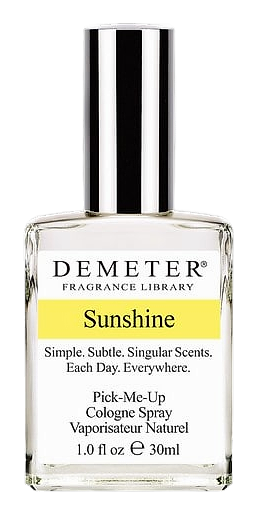
What does sunshine smell like? The team at Demeter asked themselves this question years before releasing Sunshine in 2013. After a debate that lasted more than a year, they settled on something specific: cotton, warmed by the sun. Not fresh cotton. Not clean cotton. The version that has been left outside long enough to hold the warmth of the afternoon. The execution took almost another two years from that decision. The result is a fragrance built around aldehydes and cotton, a combination that captures something genuinely difficult to pin down: not a place, not a season, but a sensation.
Aldehydes are the secret here. In perfumery, they're often used as fixatives, substances that slow down the evaporation of lighter notes and help a fragrance hold together over hours. But in Sunshine, aldehydes do more than fix. They illuminate. Their waxy, slightly soapy quality mimics the way sunlight catches on warm fabric, creating that characteristic powdery shimmer that sits at the edge of sweetness. The cotton note doesn't arrive with fanfare. It settles in quietly, supporting the aldehydes rather than competing with them.
The evolution
The opening is brief but memorable. Aldehydes rise first, soft and shimmering, like the sensation of stepping outside into unexpected warmth. The burst lasts perhaps ten minutes before the aldehydes begin their fade and the cotton heart takes over, warm, close, intimate. This middle phase is where Sunshine lives longest. The scent reads as fabric now, not as perfume: the kind of warm cotton that feels like a second skin. Vanilla threads through underneath, barely there, just enough to keep things from going flat. By the drydown, the aldehydes have settled into the skin as powdery warmth, the memory of the opening, but quieter. This is the phase that earns the "comfort" label. On clothing, the drydown can last into the next day, faintly present in the fabric. On skin, expect four to six hours depending on application. Less projection than you might expect from a cologne. More presence than you might expect from Demeter.
Cultural impact
Sunshine sits comfortably in Demeter's most-worn fragrances, appreciated by people who want scent to feel like mood rather than statement. The aldehydic structure gives it an old-world quality that newer "clean" fragrances often lack, powdery without being grandma, warm without being heavy. Community reviews describe it as "a summer day," "a white cotton tee dried on a clothesline," and "sunscreen and afternoon naps." That last one is telling: Sunshine isn't trying to smell like nature or luxury. It smells like the best part of a specific kind of day. Compared to peers like Clean Summer Day and Guerlain's Teint de Neige, it holds its own on value while offering something more understated than either.