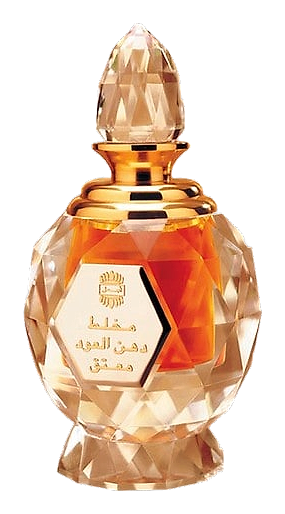

The Story
Why it exists.
The beginning
The name carries its own weight, and Ahmed Al Maghribi isn't reaching for poetry here. "Dehn Al Oud Qadeem" positions itself as a focused study in oud oil, a deliberate, concentrated take on one of the most storied materials in Arabian perfumery. Launched in 2024, it leans into the lineage of attar-style oils rather than modern blended compositions. The fragrance presents oud without dilution, without the sweeteners, florals, or fruits that often accompany the material in contemporary releases. It assumes the wearer knows what raw oud smells like, or wants to find out. There's an honesty to that approach, one that skips the modern urge to make oud approachable and instead lets the material speak at full volume.
The composition stacks Indian oud at the top, Cambodian oud at the heart, and Indian oud again at the base. That repetition defines the entire structure. The top accord hits with a sharp, almost medicinal intensity, the kind of raw, unapologetic oud character that defines unblended Arabian oils. At the heart, the Cambodian oud introduces a warmer, more resinous register, one that carries a slightly softer sweetness while maintaining the material's depth. By the time the base settles, the Indian oud returns, anchoring the drydown with that dark, leathery density.
The evolution
The first hour is a controlled assault. Indian oud hits with that sharp, almost medicinal opening, the kind of barnyard funk that makes you check whether something's wrong, or right, depending on your tolerance. There's nothing polite about it. Around the two-hour mark, the Cambodian oud starts to surface, pulling the composition toward something slightly warmer, more resinous. The sharpness doesn't disappear. It settles into a dark, leathery register that reads more like worn hide than animal waste. By hour four or five, the drydown is a deep, woody warmth that clings close to skin. The projection quiets down significantly. What remains is a dense, smoky trace, the kind of scent that surfaces when you move and disappears when you stop.
Cultural impact
Dehn Al Oud Qadeem offers something increasingly rare in the current fragrance market. It treats oud as a complete language, not as an accent or a supporting note in a larger composition. The fragrance presents itself as a direct encounter with the material, one that doesn't try to translate oud into something more palatable for wider audiences. Both Indian and Cambodian oud carry their own cultural registers, each with distinct characteristics shaped by regional processing traditions and the specific growing conditions of the Aquilaria trees.