The Story
Why it exists.
The beginning
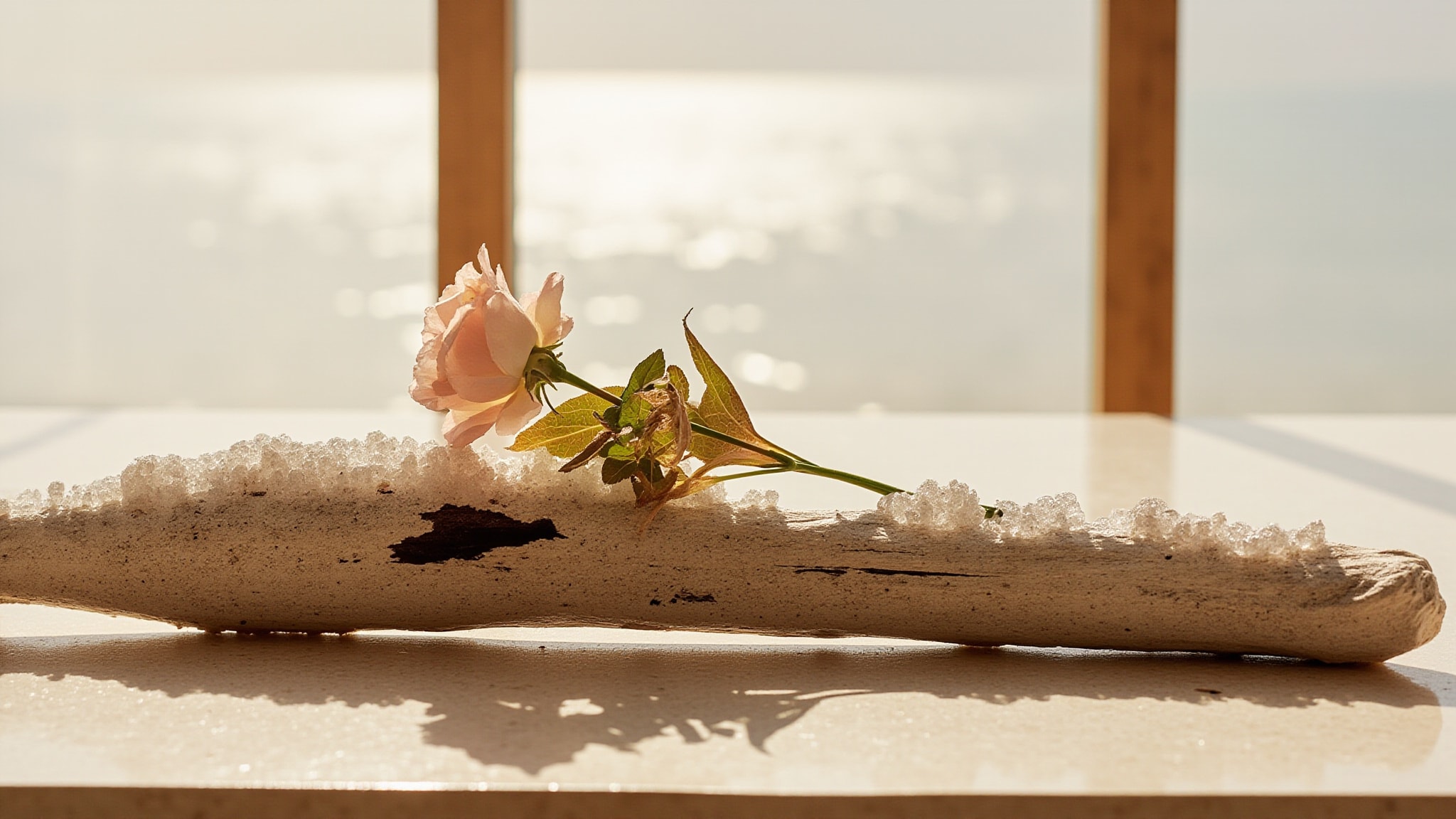
Salt Rose began with a specific place. Sarah McCartney had spent time on the Greater Thames Estuary, that strange stretch where fresh water from the river pushes against salt water from the North Sea. What caught her attention wasn't the landscape's beauty but its stubbornness. Wild roses growing in salty, sandy earth, their scent carrying traces of crushed shells and driftwood. The question was simple: what would a rose smell like if it grew up fighting the elements instead of being cosseted in a garden? McCartney brought that observation back to her West London studio, where she works through questions like this with her students as often as she does alone. The brief write-up came first, then the formulation, matching what she remembered smelling to what the materials could actually deliver.
The key structural choice here is letting salt do the heavy lifting. Not as a novelty accent, but as the spine of the composition. Sea salt provides a mineral clarity that keeps the wild rose from reading sweet or powdery, the way a rose can smell when it's been engineered toward a stereotype. Wild rose carries green, slightly bitter facets that cultivated roses lose through generations of hybridization. In an estuarine environment, those facets are amplified. Driftwood and seashells don't just support the rose, they recreate the specific aromatic environment where it grew. Sand brings warmth without sweetness. The result is a rose that smells like something that survived, not something that was arranged.
The evolution
The opening is sea salt and marine, sharp, clean, almost crystalline. The kind of clarity that hits before the rose even registers. Then the wild rose arrives quietly, not as a statement but as a counterweight. Green, slightly bitter, the rose you'd smell if you buried your nose in the actual plant rather than a bottle of its absolute. As it settles over the first hour, the salt softens and the rose begins to anchor. Sand and driftwood emerge, mineral warmth, the sun-warmed driftwood smell of a beach at midday. The rose doesn't disappear. It deepens, becoming less sweet, more resinous, as if the petals have been sitting in salt air long enough to lose their softness. By the drydown, the salt has fully retreated. What remains is a translucent rose, barely there, but unmistakable, settling into warm, dry driftwood that stays close to the skin for hours. The trajectory is a question answered: what happens when you start with the ocean and end with the earth beneath it?
Cultural impact
Salt Rose speaks to a specific wearer's instinct: someone who's tired of rose smelling like the same thing. The mineral clarity and estuarine honesty attract people who want a floral that means something beyond decoration. It's the kind of fragrance that reads as genuine rather than constructed, earned through a specific place rather than assembled from a list of popular materials.