Heritage
A house, in its own words
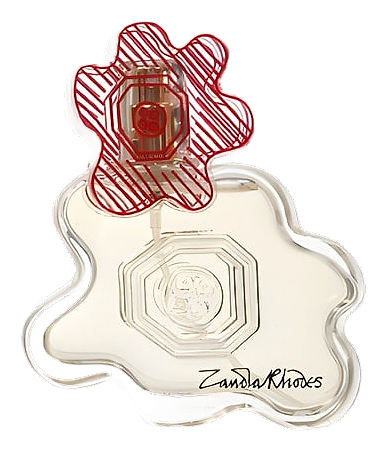
Zandra Rhodes was born in 1940 in Chatham, Kent, and raised partly in Kenilworth, Warwickshire after her family relocated during the Second World War. Her mother, a fitter for the Paris fashion house of Worth, introduced her early to couture construction and to the rhythm of seasonal collections. Rhodes studied at Liverpool College of Art and then at the Royal College of Art in London, where she graduated in 1964 with a textile-printing specialization that would shape her entire career. She launched her eponymous label in 1969, producing her first small collection that immediately drew attention for hand-screen-printed fabrics in graphic, saturated palettes. Throughout the 1970s she became a fixture of the London fashion scene, opening her first shop on Fulham Road in the early part of the decade and dressing figures including Diana Ross and Princess Anne. By 1977 she was named British Designer of the Year, the same year she received a CBE. In 1994 she extended into fragrance with Zandra Rhodes, her debut perfume, which coincided with the publication of her autobiography and a renewed public profile. A second release, Button Flower, followed in 2010. That same period also saw the establishment of the Fashion and Textile Museum on London's Bermondsey Street, which Rhodes founded in 2003; it was officially opened in May of that year by HRH Princess Michael of Kent, fulfilling a long-held ambition to create an institution dedicated to textiles and contemporary fashion. In 2014 Rhodes accepted a seat on the British Fashion Council's advisory board, a formal acknowledgment of her influence on UK design education and industry. She was appointed Dame Commander of the Order of the British Empire (DBE) in 2015, honoring a career that spans textile innovation, ready-to-wear, and the small but considered fragrance line that shares her name. Rhodes approaches fragrance the way she approaches fabric: as a surface to be printed on. Her design language is rooted in vivid color, dense pattern, and an unapologetic joy in ornament, qualities she has described as inseparable from her identity as a printmaker and her own punk sensibility, which emerged during the 1970s London scene. Where many fashion houses treat perfume as a quiet commercial extension, the Zandra Rhodes brand treats scent as another pattern, another way to be seen, another garment the wearer puts on before leaving the house. That outlook produces fragrances with personality. The 1994 launch named simply Zandra Rhodes sets the tone, while Button Flower, released sixteen years later, continues the conversation with a floral register that still carries the house's theatrical streak. Both are conceived for a wearer who wants their perfume to communicate something, not simply sit near the skin. Underpinning the philosophy is an instinct for craft preservation. Rhodes founded the Fashion and Textile Museum in part to safeguard techniques, especially screen printing, that she worried were disappearing from British education. Her fragrances sit comfortably alongside that mission: small in number, made with care, and oriented toward a confident, design-literate buyer rather than a mass audience.