The Story
Why it exists.
The beginning
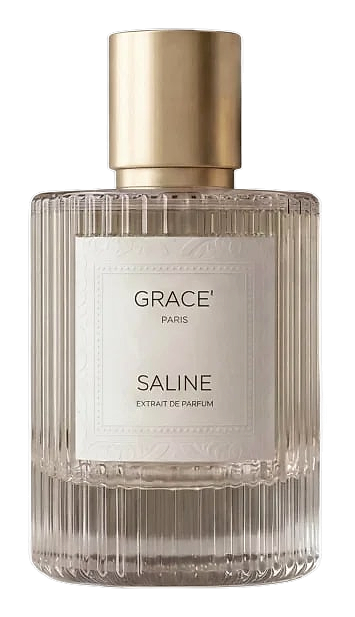
Grace' Routine released Saline in 2026 as part of a minimalist approach to fragrance making: three ingredients, one clear idea, no excess. The composition strips away every layer that doesn't earn its place, and Saline reads as the most pared-down expression of that starting point. The name itself sets the terms. Salt. The mineral trace left on skin after a wave pulls back, the taste of a coastal wind, the residue of evaporation on a cold window. There's nothing decorative in the title, and nothing decorative in the juice inside the bottle.
What makes Saline structurally interesting is how few notes it asks to do everything. Ambrette seed carries a musky, slightly sweet warmth at the top, the kind of warmth that reads as skin rather than perfume. Sea salt holds the middle, transparent and bright, giving the composition its mineral spine. Sage anchors the base, dry and herbaceous, preventing the salt from dissolving into something too abstract. Each material takes responsibility for its own territory. The ambrette warms without sweetening, the salt brightens without sweetening, the sage dries without sharpening.
The evolution
The opening belongs to ambrette seed, and the ambrette here reads warm rather than dewy. Not cotton. Not laundry. A clean musk that sits close to skin and makes you wonder if you're wearing anything at all. The sweetness is faint, almost buried under the warmth, more suggestion than statement. Then the salt arrives, and it doesn't announce itself the way aquatics usually do. There's no melon, no marine accord, no ozone shorthand. Just a flat mineral clarity that cools the ambrette down without replacing it. The two notes share space without competing, the salt sharpening the warmth while the ambrette keeps the salt from going cold. As the hours pass, sage begins to surface from underneath. Not loudly. It dries the salt out, adds a faint green bitterness, and the whole composition drifts into an herbaceous mineral musk that holds its line.
Cultural impact
Saline sits comfortably in the space of mineral, skin-close compositions that have drawn attention in recent years. It reads less like a fragrance event and more like a steady presence, the kind of scent that earns its place through restraint rather than impact. The composition doesn't compete for attention. It registers quietly, holds its shape, and lets the wearer carry it rather than the other way around. In a category often defined by loud launches and statement extraits, Saline reads as an intentional counterpoint: a scent that knows exactly what it is and never tries to be more.