Heritage
A house, in its own words
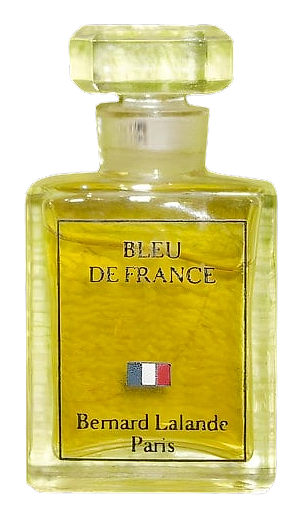
The story of Bernard Lalande resists easy summary. Documentary records of French perfume houses from the mid-twentieth century are fragmentary, and Lalande's operation appears to have been modest in scale. What can be established with reasonable confidence is that a designer by this name was active in the perfume industry by at least the early 1920s. A 1924 reference from Perfume Intelligence links Parfums B Lalande to an eau de toilette distributed through Lucien Lelong, a major Parisian couture house of that era. This connection suggests Lalande operated as either a house perfumer or a licensed fragrance label working within the network of French couture. The 1929 United States distribution of this product indicates some reach beyond French borders. By 1960, Bernard Lalande had released Bleu de France, a classical aldehyde fragrance targeting women. The name itself, translating to Blue of France, evokes a specific shade associated with French national identity, from the historic oriflamme through to the modern tricolor. Whether Lalande designed the fragrance independently or through a licensing arrangement with a fashion house remains undocumented in available sources. The absence of further recorded releases after 1960 raises the possibility that Lalande's perfumery activities were temporary or supplementary to a primary occupation in fashion, cosmetics, or related fields. What survives is the fragrance itself, now encountered primarily through resale platforms where vintage bottles occasionally surface. Without explicit statements from Bernard Lalande about his creative intentions, any assessment of his philosophy must proceed from the fragrance itself. Bleu de France, as documented in collector descriptions, belongs to the aldehyde tradition that dominated postwar French perfumery. This style favors bright, waxy top notes that introduce a powdery warmth, followed by deeper floral or woody development. The aldehyde category encompasses landmark creations like Chanel No. 5 and its contemporaries, and the fact that Lalande chose this structural framework suggests alignment with prevailing standards of feminine luxury fragrance at the time. The descriptor "classical" appearing in multiple independent accounts implies Bleu de France did not pursue radical novelty but rather worked within established conventions. This is not necessarily a limitation; many enduring fragrances of that era followed classical structures while achieving distinctive character through material quality and proportion. The single-fragrance output raises the question of intentionality. Some designers launch one signature and move on, others find that one fragrance fulfills their creative needs, and still others may have simply lacked the commercial infrastructure to expand. The absence of a surviving brand presence suggests Bleu de France was likely produced in limited quantities without sustained distribution infrastructure, making it a product of its era's quieter design culture rather than a marketed luxury brand.