Marcus R. McCoy
Marcus R. McCoy didn't arrive at perfumery through a conventional route. No Grasse summer, no chemistry degree, no family lineage of bottle-makers. His path began in the Amazon basin, where he apprenticed to a South American shaman and spent years learning from flowers that most perfumers never encounter. Working alongside his teacher, McCoy absorbed a plant-first worldview shaped by ritual and direct experience, an education rooted in the idea that aromatic materials carry voices rather than simply volatile molecules. From those early lessons in the rainforest, he carried home a conviction that scent is closer to a living language than a technical exercise. He refined that conviction through years of studying distillation and extraction, teaching himself the craft of pulling fragrance from plants by hand. McCoy eventually established House of Orpheus, his own independent perfume house, where he serves as owner, nose, and creative lead. He also works as a distiller, formulator, and herbalist through his affiliation with Rosarium Blends, handling everything from single-plant distillations to incense work. His debut editions from the house appeared in the mid-2010s, and he has continued to expand the line with a focus on alchemical and spiritually oriented compositions.
The hits
Notable creations

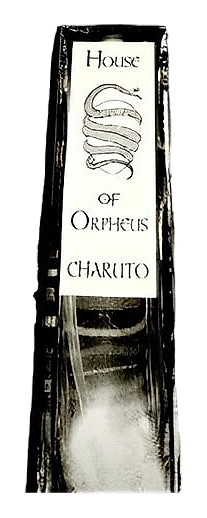

The signature
How Marcus composes
McCoy's hand shows up most clearly in botanical and resin-driven compositions, where natural extracts, tinctures, and distillates carry the structure rather than synthetic shortcuts. He works with alchemical metal oils, exotic florals uncommon in mainstream perfumery, and incense-grade materials drawn from his background in herbalism and ritual fragrance. His style favors unusual raw materials and tends to lean toward the mystical end of the spectrum, with smoke, resin, and flower absolutes appearing across his range. Technically, his strength lies in distillation and extraction work done in-house, which gives his compositions an authenticity that registers on skin. He treats each material as a complete statement, allowing individual notes to retain their character rather than blending them into smooth abstraction. The result is perfumery that smells grown rather than engineered, grounded in the slow craft of a maker who learned his trade from the plants themselves.
Philosophy
What drives Marcus
McCoy approaches perfumery as a practice closer to alchemy and listening than to formulation. The shamanic training that shaped him taught that plants speak through scent, and his work treats each aromatic material as a collaborator with its own character and intention. He builds fragrances from the conviction that a perfume can carry meaning beyond mood and beauty, functioning as a tool for focus, invocation, or inner work. Composition for him is slow and attentive, a process of drawing out what a plant wants to say rather than imposing a top-note accord onto indifferent ingredients. He has described his practice as high alchemical perfumery, an orientation that guides how he sources materials, sequences notes, and thinks about the wearer's relationship to a finished bottle. The resulting fragrances read as deeply intentional objects, often carrying names and concepts that signal the spiritual ground they were built on.
The houses