
The Story
Why it exists.
The beginning
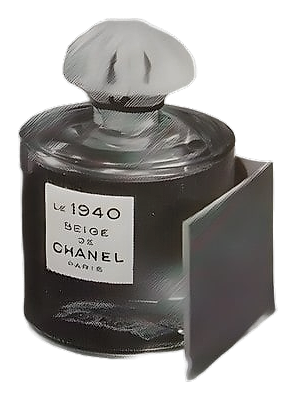
Ernest Beaux created Le 1940 Beige as a composition that shows a different facet of his vision, one that trades aldehydic abstraction for something more directly emotional. Launched in 1931, the fragrance takes its name from a color Coco Chanel made iconic: beige, the hue of tweed suits and sunlit afternoons, of clothes that last longer than trends. In naming this scent for a year rather than a place or fantasy, Chanel and Beaux made a quiet statement: this fragrance exists in time, not outside it. A woman wearing it was wearing something of her moment, a quiet confidence that spoke without announcing itself.
What makes Le 1940 Beige unusual is its structure. The iris does the work of lift and longevity instead, cool, mineral, almost vegetable in its earthiness. It keeps the jasmine honest, prevents it from becoming sentimental. The ambergris base is where things get interesting: animalic without being aggressive, it adds a skin-like warmth that oakmoss then grounds in something mossy and intimate. The result is a fragrance that smells like the inside of a Chanel jacket pocket, close, personal, experienced rather than announced.
The evolution
Iris hits the skin first, cold, powdery, with that distinctive violet-leaf bite. It doesn't open so much as settle, like dust in a sunbeam. The jasmine arrives next, pushing the composition from cool to warm, from powder to something almost creamy. Then ambergris announces itself. Not aggressively. Just enough to remind you that animals exist, that skin has smell, that perfume was once made from things that lived. Oakmoss takes over as the fragrance evolves, shifting it from floral to earthy, mossy, close to the body. What emerges is something intimate and slightly old, not dated, but present. Aware of its own history.
Cultural impact
Le 1940 Beige remains one of Chanel's lesser-known compositions, a fragrance that rewards those who seek rather than accept. Its powdery iris and animalic ambergris place it firmly in the Chanel tradition of restrained luxury, while the oakmoss drydown connects it to an era when perfumery still carried traces of the natural world. The scent embodies a quiet confidence, an understated elegance that speaks to those who appreciate depth over volume, subtlety over spectacle. It exists as a testament to the idea that the most compelling fragrances are often the ones that require attention to discover.