Prince Georges V. Matchabelli
Prince Georges Vasili Matchabelli arrived at fragrance almost by accident, a detour worthy of his station. Born in 1885 into Georgian nobility in Tiflis, the young prince set off for Berlin to study mining engineering. It was there, surrounded by a continent in love with its own reinvention, that he stumbled into perfumery through a friend's predicament: a lady searching for a particular scent and finding nothing. Matchabelli, an amateur chemist with a restless curiosity, decided to make it himself. The Soviet invasion of 1921 sent the prince into exile, carrying him to the United States with his wife, the actress Norina, who became Princess Norina Matchabelli. In 1924, the couple formalized what had begun as a noble hobby, establishing the Prince Matchabelli Perfume Company. By 1928, he composed a perfume honoring Georgian Queen Tamar, an early statement of intent that memory and homeland could be bottled. His aristocratic address book served as both clientele and calling card, with custom compositions for figures such as Princess Marie, a quiet apprenticeship in the politics of taste.
The hits
Notable creations
The signature
How Prince composes
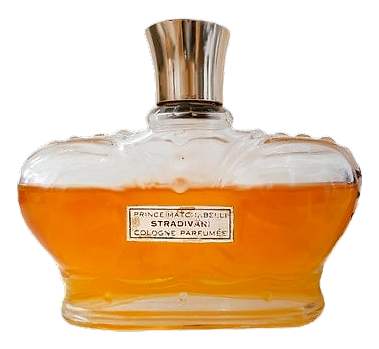
Working from his amateur chemist's foundation, Matchabelli built his formulas through instinct and iteration, blending in the tradition of the self-taught artisan rather than the structured perfumery curriculum. His compositions tended toward the romantic and commemorative, weighted with florals and orientals that suited the gilded expectations of his cosmopolitan clientele. He favored opulent presentations, ornate crown-topped bottles that telegraphed his heritage before the juice was even sprung. His preference for narrative fragrance, scents built around a person or memory, gave his work a literary quality that set him apart from contemporaries chasing abstract trends. The result was perfumery as personal correspondence, sealed with wax and waiting to be opened.
Philosophy
What drives Prince
Matchabelli believed perfume was a private language, a coded message between the wearer and those close enough to lean in. Coming to perfumery without formal training freed him from the conventions of the great French houses. He approached scent as a nobleman would: with conviction, with generosity, and with an instinct for occasion. Each creation carried narrative weight, whether a tribute to a queen, a portrait of a princess, or a gift for a friend. He treated fragrance as biography, a liquid keepsake that could summon a person, a place, or a moment long after the bottle was emptied. His compositions suggest someone more interested in evoking than impressing, more concerned with intimacy than spectacle.
The houses
Maisons Prince composes for
In the same league