Nicky Verfaillie
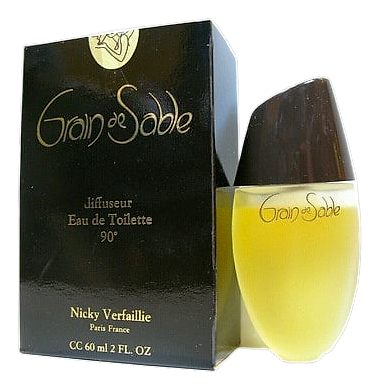
Monique Verfaillie began in fashion, a training ground for instincts about silhouette, texture, and the character of a finished object. She later turned that visual sensibility toward perfume and established her own namesake line in Paris in the late 1970s. Her early work appears in 1977, when three fragrances entered the market, including Grain de Sable, a bright fruity floral built around melon, peach, citrus, basil, and a marine accent. The name Nicky Verfaillie became shorthand for polished Parisian perfumery with a daring edge. Though her catalogue is now difficult to encounter, her house occupies an intriguing place between fashion-house elegance and the audacious, saturated compositions of the late 1970s.
The hits
Notable creations
The signature
How Nicky composes
Her most recognizable fragrance opens with a lively fruit salad: melon, peach, and citrus, sharpened by basil and lifted by Calone’s marine, mineral effect. Those bright materials are treated not as a simple tropical sweetness but as the opening of a more polished composition, supported by woody and spicy notes beneath. This is characteristic of late-1970s perfumery, when fruit could feel crystalline and modern, marine notes could add coolness, and woods gave a fresh floral greater structure. Verfaillie’s approach favors contrast, pairing sweetness with green herbs, freshness with spice, and a buoyant top note with a darker, more tactile base. Grain de Sable is the clearest surviving expression of that sensibility.
Philosophy
What drives Nicky
Verfaillie’s background in fashion suggests a fragrance philosophy built around the same principles as a well-cut garment: balance, impact, and coherence. Grain de Sable pairs the freshness of fruit and citrus with an ozonic, watery note, then anchors the result in a woody-spicy structure. That combination gives the composition movement without losing its sense of finish. Her work seems driven by the idea that scent, like clothing, should establish a presence immediately while remaining controlled. The Parisian identity of the house also points to an interest in perfume as an accessory of character, something that can define a wearer before a word is spoken.
The houses