Apostolos Zanias
Apostolos Zanias operates from the dark heart of Athens, where his temple-like studio, St. Narcissus, functions less like a traditional perfumery and more like a house of worship. Trained as a photographer and visual artist, Zanias came to perfumery through an adjacent path, bringing with him a cinematic eye and a fixation on ritual, transformation, and self-devotion. He launched St. Narcissus as a niche house built on darkwave aesthetics, producing handmade fragrances in small batches from Greece. His reach has already extended well beyond his home city: his work appeared at Tate Modern as part of a tribute exhibition to Leigh Bowery, where he created a prop bottle for the occasion. Zanias wears many hats at his brand, handling art direction, photography, and composition, and his fragrances read as extensions of a larger visual language rather than standalone products. He has spoken publicly about the technical demands of perfumery, comparing it to beer production, where masking alcohol's presence becomes the real craft.
The hits
Notable creations

The signature
How Apostolos composes
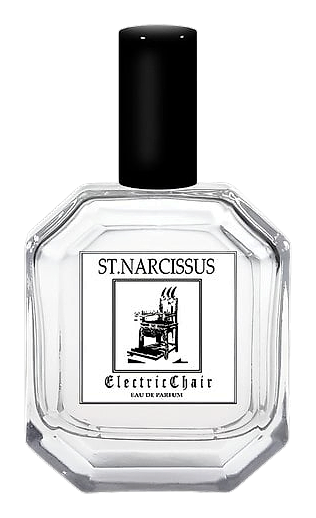
Zanias works with a raw, provocative material palette that signals his darkwave credentials: smoke, leather, metallic notes, and mineral accords recur across his compositions. He gravitates toward textures that feel industrial or punitive rather than soft, often layering dry, ashy, and metallic elements to create something that reads almost sculptural on skin. His fragrances tend toward the conceptual and often carry charged titles, like Electric Chair, that demand the wearer sit with discomfort. Because everything is handmade in small batches in Athens, he can afford to chase ideas that larger houses would never greenlight. The result is a body of work that feels closer to contemporary art than to traditional perfumery, and that is precisely where Zanias wants it.
Philosophy
What drives Apostolos
For Zanias, fragrance is ritual first, scent second. He has described his space as a cult of self-love, transformation, and devotion, and every composition seems to orbit that triad. His approach rejects the polite, crowd-pleasing instincts of mainstream perfumery in favor of something closer to theater or ceremony. He treats smell as a language for states that words alone cannot reach: violence, ecstasy, grief, transcendence. The visual world he constructs around his bottles, from the darkwave iconography to the religious undertones of the St. Narcissus name, is not packaging but an extension of the formula itself. He believes a fragrance should alter the wearer, not simply decorate them, and he designs with that threshold in mind.
The houses