




The Heritage
The Story of Mugler
Mugler is not a perfume house, it's a galaxy of its own. Known for audacious, otherworldly fragrances that defy convention, the brand creates olfactory blockbusters like Angel and Alien that are instantly recognizable and impossible to ignore. Mugler makes scents for main characters, bottling fantasy, excess, and a vision of a powerful, futuristic femininity.
Heritage
The story of Mugler fragrance begins with the spectacular vision of its founder, Manfred Thierry Mugler. A former ballet dancer and interior designer, he launched his Parisian fashion house in 1974, quickly becoming famous for his architectural, hyper-feminine, and theatrical runway shows. He saw clothing and perfume as tools for transformation, a way to create a larger-than-life persona. In 1992, in partnership with Clarins Group, he turned the fragrance world on its head with the launch of Angel. It was a shocking, polarizing scent with no floral notes, built on an overdose of patchouli and the candy-floss scent of ethyl maltol, effectively creating the first 'gourmand' perfume. Angel's success was monumental, proving that daring creativity could also be a commercial juggernaut. It established a blueprint for the house: create a pillar fragrance with a powerful, unique signature, house it in a sculptural, refillable bottle, and build a universe around it. This was repeated in 2005 with the launch of Alien, a mystical and radiant jasmine sambac fragrance that became another global icon. After decades under Clarins's stewardship and the founder's passing in 2022, the brand was acquired by L'Oréal in 2019, which continues to shepherd its celestial legacy into the future.
Craftsmanship
The creation of a Mugler fragrance is an exercise in audacity. The house is famous for its use of 'overdose', where a perfumer takes a single ingredient and pushes its concentration to an extreme, creating a shocking and unforgettable effect. This was the case with Angel's patchouli and Alien's jasmine sambac. Mugler perfumers are not afraid to use high-impact synthetic molecules alongside precious natural absolutes to achieve their otherworldly effects, creating smells that simply don't exist in nature. This blend of the natural and the technological is a hallmark of the house. Long before it was a trend, Mugler championed sustainability through its bottle design. Since the launch of Angel in 1992, the house has offered a refill service called the 'Source', an in-store fountain that allows customers to replenish their treasured bottles. This treats the perfume bottle not as disposable packaging, but as a precious, lifelong object. This commitment to 'responsible luxury' is a core part of their process, merging ecological consciousness with the brand's signature opulence.
Design Language
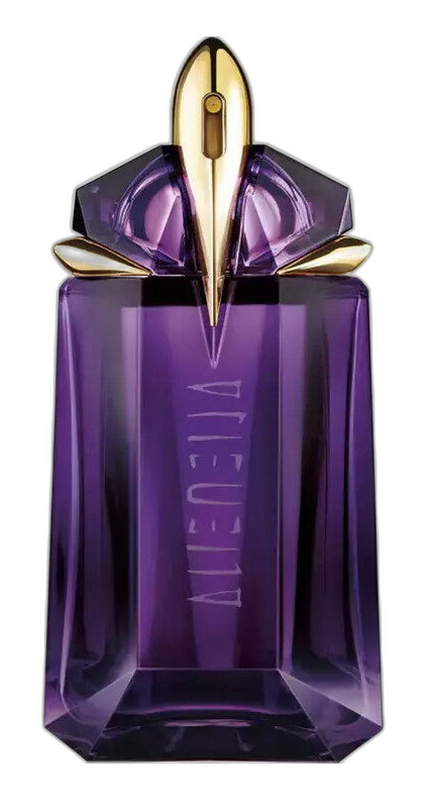
The visual language of Mugler is as important as the scent itself. The bottles are not mere containers; they are sculptural, celestial objects meant to be displayed and cherished. The iconic five-pointed star for Angel, carved like a piece of sky, and the deep amethyst talisman for Alien, resembling a sacred jewel from another world, are masterpieces of glassmaking. They feel substantial and precious in the hand, more like art objects than commercial products. This design philosophy extends from Manfred Thierry Mugler's own architectural and futuristic fashion sensibility. The sharp angles, cosmic colors, and crystalline forms reflect the structure and power of the fragrances within. The packaging and advertising create a complete fantasy, inviting you into a world of celestial goddesses, futuristic heroines, and cosmic wonder. It's a look that is instantly recognizable: bold, sculptural, and unapologetically glamorous.
Philosophy
Mugler's creative drive is rooted in metamorphosis. The house doesn't create pretty scents; it creates fragrant armor and olfactory signatures. The philosophy is one of unapologetic presence, encouraging the wearer to become the heroine of their own story. Mugler fragrances are deliberately structured and often built around a creative tension, like the clash between patchouli and praline in Angel, or the solar-versus-mineral feel of Alien. They're not designed for quiet moments. This approach rejects the traditional codes of subtle, romantic perfumery in favor of something bold, futuristic, and fantastical. It's about excess done with precision, creating scents that are both divine and a little bit dangerous. The brand believes a perfume should be as memorable as the person wearing it, leaving an unforgettable trail, or 'sillage', that announces your arrival and lingers long after you've left.
Key Milestones
1974
Manfred Thierry Mugler founds his eponymous fashion house in Paris.
1992
Launches his first fragrance, Angel, a groundbreaking scent that establishes the gourmand category.
1992
Introduces the 'Source', an in-store perfume fountain for refilling bottles, pioneering sustainability in luxury.
2005
Releases Alien, a jasmine-forward fragrance that becomes the house's second global pillar.
2019
L'Oréal acquires Mugler fragrances and fashion from Clarins Group.
2022
Founder and visionary Manfred Thierry Mugler passes away at the age of 73.
At a Glance
Brand profile snapshot
Origin
France
Founded
1974
Heritage
52
Years active
Collection
1
Fragrances released
Avg Rating
4.0
Community sentiment