Iulia-Victoria Neagoe
Iulia-Victoria Neagoe spent the first years of her life in her grandmother's garden, macerating flowers and hunting for aromatic plants without knowing she was already practicing perfumery. At four years old, she smelled everything in sight. Her parents, adhering to the Romanian principle that a trade is golden, steered her toward engineering. She followed: Faculty of Construction in Bucharest, a master's in Management, a program in interior design. The perfumes never left her. She added a master's in biochemistry in Austria, where she worked at Marionnaud cosmetics and learned the retail side of the industry. Her husband pushed her to formalize what she already knew. At the end of 2013, she founded Luviane Atelier de Parfumerie, an anagram of her own name, and launched her first collection in 2014. Ten years later, she runs the workshop alone, the sole architect and nose behind a brand that refuses to be anything but Romanian. She completed a doctorate. She hosts olfactory workshops where clients blend their own formulas from over a hundred natural ingredients. Her laboratory sits in the Republica district of Bucharest, inside the halls of a former factory that now smells of hyacinth and iris.
The hits
Notable creations
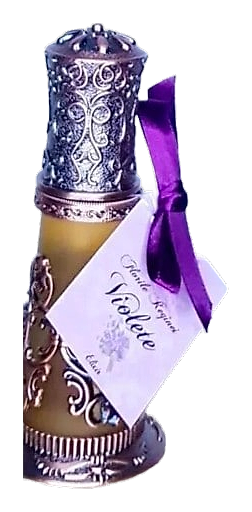
The signature
How Iulia-Victoria composes
Neagoe gravitates toward rare flower essences: hyacinth, iris, violet, lavender, tuberose, jasmine, rose. These form the botanical vocabulary of her collections. She favors solid and liquid perfumes, as well as ambient fragrances, all using certified natural raw materials. Her formulas reflect her biochemistry background, translating scientific understanding into olfactory texture. Each collection ties to Romanian identity: folkloric plants, traditional symbolism, named hypostases of a woman's life. The graphic elements accompanying her bottles echo the same cultural specificity. Nothing in her work approximates a French template.
Philosophy
What drives Iulia-Victoria
For Neagoe, perfumery is not a product category. It is a form of living. She approaches fragrance as therapy, studying the connection between scent and psychology through the lens of aromacology. Her Perfumes of Medicine collection emerged from years of research into how specific formulations can address emotional states such as insomnia. She works only with natural ingredients, drawing on plant knowledge passed through generations of her family, where gathering and combining herbs was never nostalgia but routine. Her creative decisions are guided by the belief that a perfume must carry both botanical precision and emotional truth. She calls herself the orchestra, conducting every step from raw material selection to the final label.
The houses