




The Heritage
The Story of Acqua di Parma
Baron Carlo Magnani created Acqua di Parma in 1916 as his own signature scent. What began as one fragrance has become synonymous with Italian sophistication. Colonia, the house's founding creation, holds the distinction of being the first true Italian Eau de Cologne, and it remains unchanged today. Over a century later, the house still captures the essence of la dolce vita, pairing Mediterranean brightness with an understated luxury that appeals to those who prefer refinement to ostentation.
Heritage
Acqua di Parma was born in 1916 in the historic heart of Parma, when Baron Carlo Magnani commissioned his personal cologne from a local perfumery. Magnani, heir to a noble family, sought to capture the sunlit elegance he associated with his homeland during his travels abroad. The result was Colonia, a fresh citrus composition that broke from the heavy, Germanic fragrances dominating the market at the time. It became an instant success among Parma's elite, who adopted it as the finishing touch to their evening attire. During the 1950s, Hollywood actors discovered the fragrance at the city's bespoke tailor shops, spreading its reputation internationally. The house remained a well-kept secret of connoisseurs through the 1960s and 1970s. In the 1990s, three passionate Italian entrepreneurs acquired the brand, ushering in a new era of expansion that included women's fragrances, the Blu Mediterraneo range, and luxury home products. The first boutique opened in Milan's Via Gesù in 1998, cementing the brand's transition from artisan fragrance house to global luxury lifestyle label.
Craftsmanship
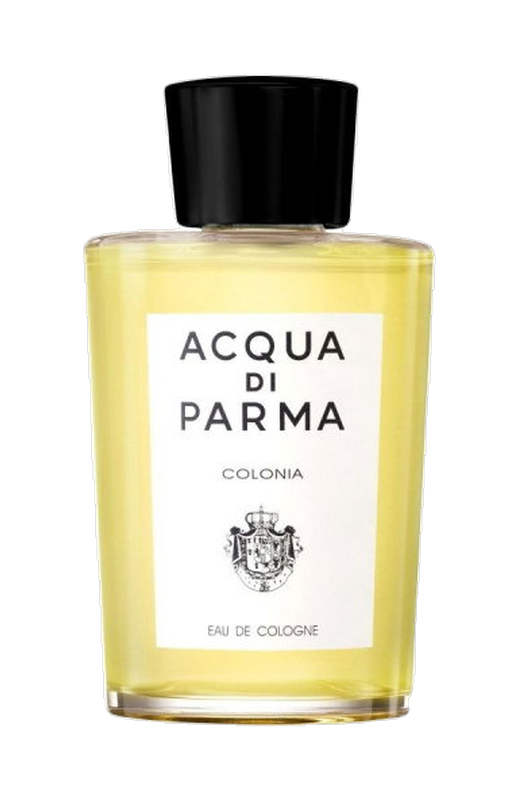
The creation of Colonia remains anchored in its 1916 origins, with natural Italian citrus oils forming the backbone of the formula. Bergamot, lemon, and orange are sourced from Mediterranean groves, then distilled using traditional methods. The opening burst of citrus gives way to a heart of lavender, rosemary, verbena, and damask rose before settling into warm vetiver, sandalwood, and patchouli. Each fragrance is composed in the Italian tradition, prioritizing clarity and balance over complexity for its own sake. The iconic yellow boxes reflect the sun-warmed stone of Parma's palazzi, while labels are applied by hand in keeping with artisanal practices established at the founding. The Art Deco bottle design, introduced in the 1930s with its characteristic black Bakelite stopper, has remained virtually unchanged, a testament to the timelessness of the original vision.
Design Language
The Acqua di Parma visual world is defined by Parma yellow, a warm golden hue that has become the house's signature color. This shade was specifically chosen to echo the sunlit stone of the city's historic palaces. Fragrances arrive in cylindrical hatboxes inspired by the bespoke tailoring tradition where Colonia first gained fame, when tailors would spritz the scent before handing over a finished suit. The boxes feature a tactile texture reminiscent of fine fabric, and their architectural shape nods to Parmese building design. The Art Deco glass bottles, with their clean geometric lines and black Bakelite stoppers, have been in production since the 1930s and remain instantly recognizable. Labels are applied individually by hand, a detail that maintains the handcrafted quality the brand has preserved for over a century.
Philosophy
Acqua di Parma embodies what Italians call arte di vivere, the art of living. The house pursues luxury that whispers rather than shouts, finding beauty in simplicity and restraint. Each product extends this philosophy beyond fragrance into grooming, home, and lifestyle collections, unified by Italian craftsmanship and natural ingredients from the Mediterranean landscape. The brand moves forward while honoring its founding principles, refusing to sacrifice heritage for trends. This measured approach to luxury attracts those who value substance over spectacle, making Acqua di Parma a quiet marker of taste rather than a loud declaration of status.
Key Milestones
1916
Baron Carlo Magnani creates Colonia as his personal signature scent, establishing Acqua di Parma in Parma, Italy
1933
The iconic Art Deco glass bottle with black Bakelite stopper is introduced
1950
Hollywood actors discover Colonia at Italian bespoke tailor shops, propelling international fame
1998
The first Acqua di Parma boutique opens on Via Gesù in Milan
1999
The Blu Mediterraneo range launches alongside Profumo, the brand's first women's fragrance
At a Glance
Brand profile snapshot
Origin
Italy
Founded
1916
Heritage
110
Years active
Collection
1
Fragrances released
Avg Rating
4.1
Community sentiment