Character
The Story of Suspended Saffron
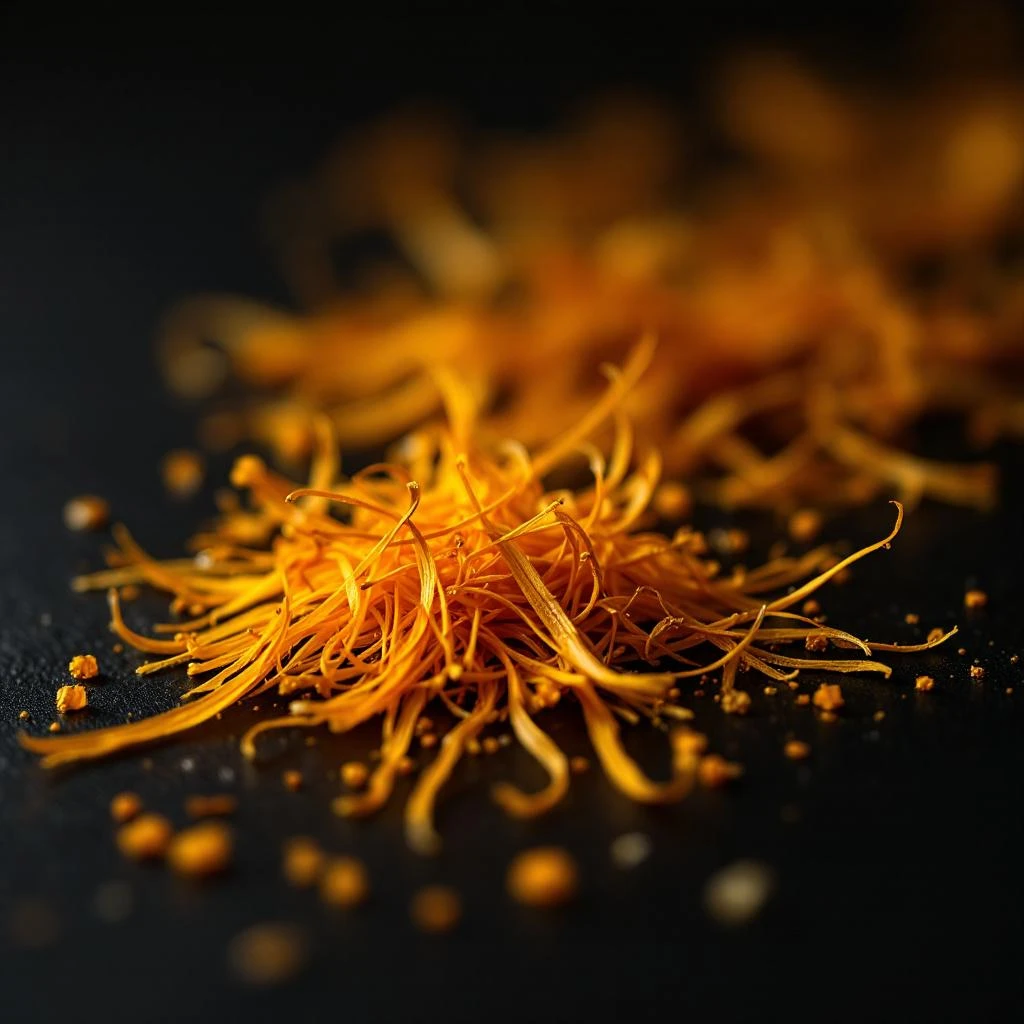
Few ingredients demand such meticulous handling. The vivid crimson stigmas of Crocus sativus yield an oil so reactive it oxidizes within hours of extraction—forcing perfumers to work under sealed, inert atmospheres just to capture the scent. The result is one of the most coveted fragrance materials on earth: warm, leathery, honeyed, and utterly irreplaceable.
Heritage
Saffron traces its cultivated lineage to Crocus cartwrightianus, a wild crocus native to the eastern Mediterranean. The sterile triploid form we know today, Crocus sativus, appeared through centuries of human selection and propagation—a plant that can only reproduce through human-divided corms, never from seed. Ancient Egyptian perfumers incorporated saffron into scented waters and ointments; Greek hetaerae courtesans wore it as a personal fragrance; physicians in Gaza prescribed it in aromatic remedies. The Romans scattered dried petals across public floors to scent grand occasions, while Persian physicians documented its medicinal applications. Saffron entered Europe through Spain following the Moorish conquest in the 7th century. By the 16th century, English saffron from the fields around Saffron Walden commanded the highest prices globally—earning the town its name. Kashmir now produces some of the world's most prized saffron, grown at altitude on the shores of Dal Lake. Despite four thousand years of use, the flower remains unchanged: harvested at dawn, before the petals open, the crimson stigmas handled with the same care as in antiquity.
At a Glance
2
Feature this note
Iran
Primary source region
Ingredient Details
Supercritical CO2 extraction / Solvent extraction
Dried stigmas and styles (crimson red)
Did You Know
"It takes roughly 170,000 hand-picked flowers to produce a single kilogram of dried saffron stigmas—yielding only about 500 grams of usable resinoid for perfumery."